
- Collected
- Article
Why mentorship matters to writers
- 26 September, 2025
- Katy Massey
For Katy Massey, an acclaimed memoirist, novelist, editor and tutor, supporting other writers is a key part of her working life that is just as important for her own practice and livelihood as it is to the new writers she works with.
Here, as Katy prepares to start her first term as an RLF Fellow at the University of Sussex, she takes a look at the vital role mentoring can play in terms of demystifying language, creating opportunities and opening doors to new experiences – for mentor, as well as mentee.

Katy Massey
I have tutored and mentored other writers for many years. When earnings from publishing have been slow to arrive or are simply non-existent, supporting other writers has become an essential part of my survival. Mentoring is also part of my artistic practice, and I have published the work of more than 50 first-time authors in anthologies.
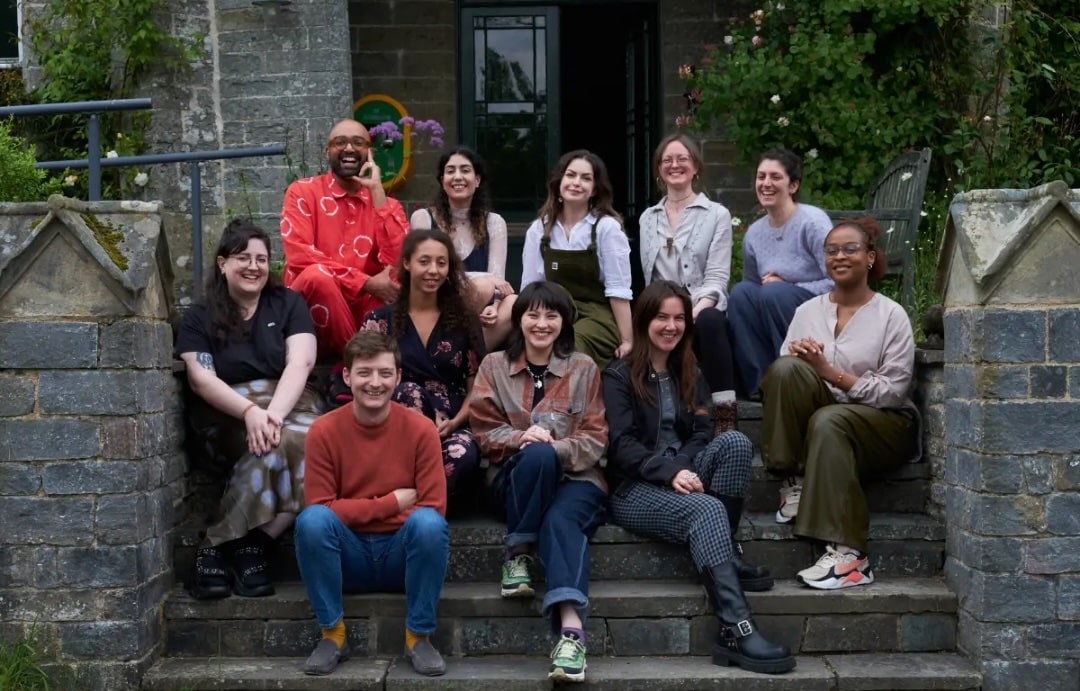
So, when I was recently offered a mentoring role I had never come across before – as a pastoral mentor for writers on New Writing North’s A Writing Chance scheme (pictured above, photo by Dan Haworth-Salter) – I was intrigued. I didn’t know then that it would change what I believed about writing development and make me reassess my own writing journey.
Previously, I saw one-to-one mentoring as simply helping to improve mentees writing (which it is of course) as well as a potent agent for broadening participation in the literary arts. I now also see it as a more holistic process, and perhaps a more complicated one too.
When I was invited to be part of the Writing Chance scheme, I had little idea what a ‘pastoral’ role would entail, but I was happy to contribute to a programme with such an excellent reputation for bringing forward new talent.
I was to meet with four emerging writers eight times over the year-long programme. But I was not there to improve their written work – publishing professionals were in place to do that. Rather, I would support them in fulfilling the expectations of their industry mentors and help them make the most of the opportunities the programme afforded.
This seems simple, but in practice it was a learning curve both for me and the participants. The first shock I experienced was to realise that I had an enviable ‘insider’ status for writers who have no connections within the industry.
It follows that my mentees felt like outsiders to a world where the main functions are carried out behind closed doors. Commissioners, desk editors, copywriters, rights executives and the rest, might as well be magicians for all the mentees had experienced of their work.
My mentees were diverse, aged from early 20s to mid-40s, with a wealth of experience in different fields, but all of them found the publishing process almost completely opaque. So, I was able to offer them the benefit of my experience publishing books, an insight which I hadn’t hitherto appreciated the value of.
Unsurprisingly, they experienced difficulties negotiating the usual unspoken conventions which are alive in the relationships between publishing professionals, agents and writers. These modes of behaviour and expectations have of course built up over time, and I saw that they can prove hugely off-putting to novices.
A lot of the time I spent with my mentees was spent decoding how the publishing industry works, and what different behaviours and language actually mean. It really exposed to me how exclusionary this is – if you have guidance and contacts, it is much easier to navigate. Without, it is very difficult.
In addition, I saw some instances of deploying these conventions deliberately, leading to gate-keeping behaviour which kept ambitious but unnetworked writers at bay. This compounded the common feeling among the working-class and underrepresented writers I worked with that they were seen as unusual, even exotic.
Another surprise was how much ‘being a writer’ in the world today meant developing abilities which fall outside our main skill set of putting words together. These were numerous: handling social media, networking with strangers, negotiating relationships with industry professionals, contributing to group activities – the list goes on. Where extra help was needed, and I couldn’t provide it, I fed back the request to New Writing North.
Questions ranged from ‘I haven’t heard from my writing mentor for a week. Should I phone them?’ and ‘A week at the Arvon Foundation should have been fun but I felt such a fraud…’ to ‘Help! I have to give a presentation about my collection, and I’ve never done public speaking before…’ and ‘It’s been two months and still no feedback. Is this agent ghosting me?’ Each meeting became about encouraging the mentee, sharing what expertise I had and problem-solving.
It has been an invaluable experience and one which has informed my role as incoming Fellow at the University of Sussex. I will have an Advisory Fellow acting as my mentor, and I will enjoy having someone at my back with whom to discuss this new challenge. But I will also be alive to the potential barriers preventing students from making the most of their studies, most of which are entangled with, but not separate from, their academic writing.
For example, issues such as unfamiliarity with academic terms and phrases, lack of confidence in one’s own ability to formulate responses to questions and little practice in arguing for an idea or a conclusion which the student feels is relevant and interesting but needs validation in order to assert it as such in a piece of written work.
Finally, working as a pastoral mentor has reminded me of my own writing journey. For me, this began with an MA and a PhD in Creative Writing. I suffered from all the above – most of which can be summarised as not feeling good enough!
And, while my supervisors were there to improve my academic work, my personal confidence as a mature student and an emerging writer was challenged by depersonalising and confusing academic procedures and systems. In my new role, I will endeavour to be the kind of RLF Fellow I wish I had been able to call on.
For more about New Writing North and the A Writing Chance scheme, visit the website.
This article originally appeared on our Substack.
You might also like:

Eleven tips to help you become a better writer
“You have to sit down and do it and keep on doing it until you get there.” Our RLF Fellows…
How practical writing skills can create empathy
“We go deeper than somebody who rocks up and delivers a course.” – Katie Grant and our other RLF Consultant…

How to cultivate resilience: a toolkit for writers
Writer, coach and RLF Fellow Katherine Clements on how to navigate a creative life