
- Collected
- Article
A Conradian voyage: following in the footsteps of Joseph Conrad
- 3 December, 2025
Before settling in the UK, the author Joseph Conrad – born on this day in 1857, in the now-Ukrainian city of Berdichev to a fiercely patriotic Polish family – was a highly experienced sailor. A naval officer in first the French and then the British merchant marines, he travelled the world for almost 20 years before publishing his first book in 1895.
Many of his experiences at sea would later find their way into his work, which is often praised for its distinctive prose style. In 1908, when Conrad made the second of two applications for financial assistance from the Royal Literary Fund, the writer John Galsworthy said of him that “no living writer of English… better deserves support,” and his applications were also supported by HG Wells, JM Barrie and Henry James.
Professor Robert Hampson, Chair of the Joseph Conrad Society (UK), is an expert on Conrad’s work, having written and edited many books about the author. Here, he takes a closer look at Conrad’s letters to the RLF:

Robert Hampson
My first encounter with Joseph Conrad was via his short story Youth. Someone must have thought this account of youthful adventures at sea would be attractive to a teenager but I was too young to appreciate the interplay between the two perspectives in the story: the disillusioned middle-aged narrator and the enthusiasm of the young man he had been. I had to wait a few more years for the overwhelming effect of reading Heart of Darkness, when I was swept along by the power of the language. Then came the deep dive as an undergraduate into Conrad’s great works, Nostromo, The Secret Agent and Under Western Eyes. It was many more years before I appreciated the financial strain that was the background to the writing of these future works of World Literature.
The only child of Apollo and Ewa Korzeniowski, who effectively gave their lives in the cause of Polish independence, Conrad left home as a teenager for a life at sea. After serving for many years in the British merchant navy and finally reaching the rank of captain, he published his first novel at the age of 37. Almayer’s Folly came out in April 1895. It was well-received critically, but, despite many reviews in daily and weekly papers, the sales were disappointing. By this time, however, Conrad had already started work on his second novel, An Outcast of the Islands, which was published in March 1896 and received a vast number of overwhelmingly positive reviews. These reviews must have re-assured him about his change from a nautical to a writing career – but, once again, good reviews did not lead to significant sales.
He is one of the most interesting & striking novelists of the new generation… his successive books have been real literature, of a distinguished sort.
Henry James on Joseph Conrad, from his 1902 letter to the RLF
On the death of his uncle in 1894 Conrad had been left a small inheritance, which he received early in 1895. He invested this in a South African mining company. In June 1896, he received news of the failure of this investment. He now found himself with a wife – he had married Jessie George in March 1896, shortly after the publication of An Outcast of the Islands – and, two years later, with his first child. Now with his pen as the only means of making money, worse was to come: at the start of 1904, his wife had a bad fall and injured both her knees. This was the beginning of what would become a permanent disability, and many years of expensive medical bills.
By 1902, Conrad had published two of the works on which his future reputation was built – Heart of Darkness and Lord Jim – as well as short fiction in various magazines. He had still not achieved commercial success, however, and was in dire straits financially. Expenditure continued to exceed income and he became burdened with debts, leading his main publisher William Blackwood to tell him he was “a loss to the Firm”.
Conrad wrote despairingly to his friend and collaborator Ford Madox Ford: “What creature would be mad enough to take upon itself the task of a creator?”
This was the context for Conrad’s first application to the Royal Literary Fund, organised by influential man of letters Edmund Gosse. He offered as justification for the award Conrad’s “slowness of composition and want of public appreciation” and procured letters of support from Henry James and Pearl Richards (who wrote under the name John Oliver Hobbes). James began his letter of support with the justified observation that “in spite of his admirable work” Conrad “was not so known to a wide and promiscuous public”. He hailed Conrad as “one of the most interesting & striking novelists of the new generation”, whose “successive books have been real literature, of a distinguished sort.”
Conrad received £300. In his letter of thanks to RLF secretary Arthur Llewelyn Roberts, he wrote: “Besides the material assistance there is in such recognition an amount of moral support which to a worker toiling in anxiety and doubt is altogether priceless”. Less formally, he later wrote to Ford to say “something has turned up”, sending him £10 “against interest and rent”.
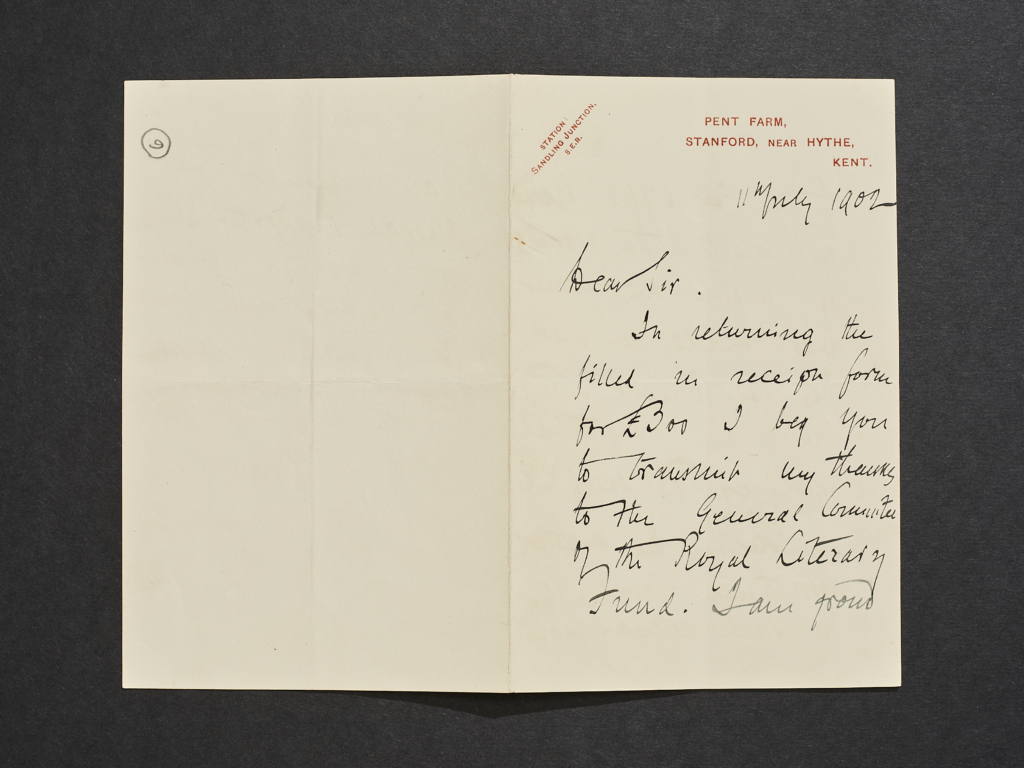
A letter from Joseph Conrad to the RLF dated 11 July 1902. © Trustees of the Joseph Conrad Estate.
Conrad’s second appearance in the RLF archives was in January 1908. This time, he wrote in support of Ford’s own application for an RLF grant. He praised Ford’s work as “a considerable performance” which “appears to hold too the promise of a still more noteworthy achievement”, and he described Ford’s circumstances as being down to “his material difficulties caused by unexpected money losses and the long illness of his wife”. In May 1908 Ford’s wife, Elsie, was diagnosed with tubercular kidney and Ford had to borrow £440 to pay for the surgery and post-operative nursing. Conrad was very familiar with the financial costs of surgery and post-operative nursing because of his own wife’s condition. Indeed, their position was no better than Ford’s. Conrad needed money again himself for further knee surgery for his wife, and he had also amassed heavy medical bills for his sons during the previous year. In addition, he owed a considerable debt to his literary agent, J. B. Pinker, who had effectively supported him financially for almost two decades. The situation was so bad that he had no money to pay his coal bill and the house was accordingly unheated; there were also school-bills unpaid and many other debts besides.
In the face of this financial crisis, Conrad applied for a second RLF grant in March 1908. This time he was sponsored by HG Wells, JM Barrie and John Galsworthy. Galsworthy wrote truthfully that he knew “Mr Conrad’s circumstances very intimately” and that his life since becoming a writer had been “a long struggle to keep his head above water”. He observed that Conrad has been “incessantly hampered by the illnesses of his family and himself”, being “laid up with gout” for some months. He concluded: “no living writer of English… better deserves support”. Wells was more succinct: “Conrad, that great artist, is hard-up again”. He was awarded £200.
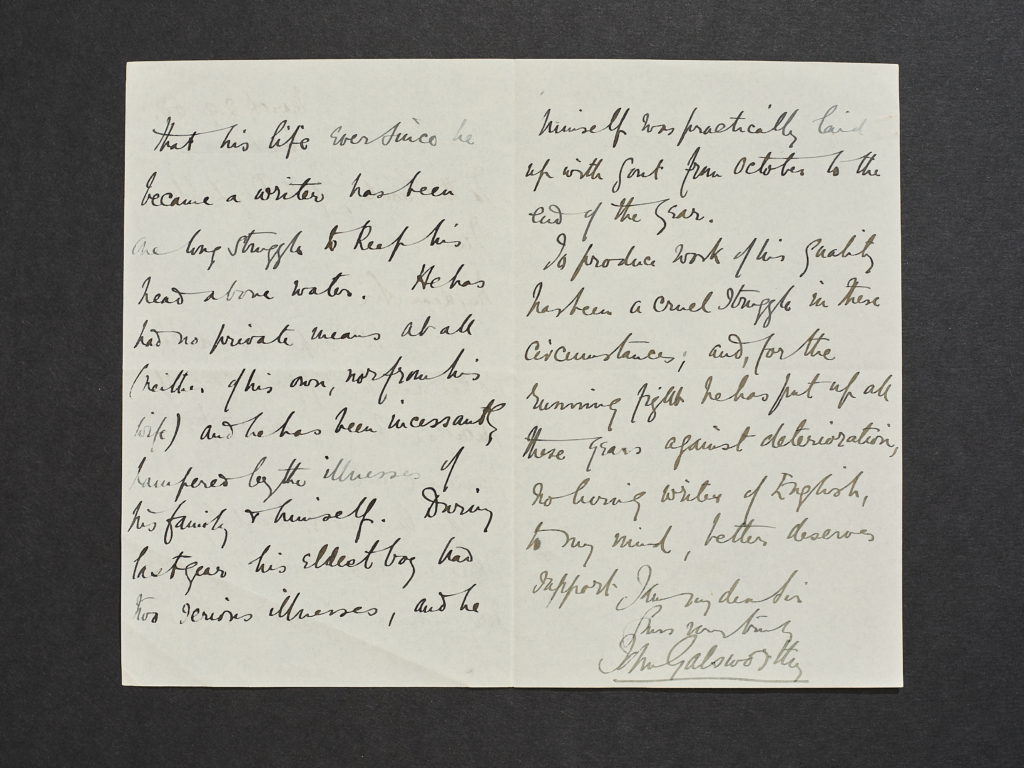
The second page of John Galsworthy’s letter to the RLF in support of Joseph Conrad, dated 1908. © All rights and credits are attributed to the owner. No copyright infringement is intended.
By this time, Conrad had published The Secret Agent and his great, prescient critique of neo-colonialism, Nostromo, and was working on Under Western Eyes, in which he aimed to capture “the very soul of things Russian”. Although his work continued to be highly regarded critically and within in the literary world, he was forced to face the idea that there was something in his writing that was “unsympathetic to the general public”. The answer, he assumed, was his “foreignness”. To another correspondent, he observed: “The great middle class knows my name, but not my books”.
It was only with the publication of Chance in 1914 that Conrad at last gained popular success. Conrad’s American publisher Doubleday mounted a promotional campaign for the book, which became a best seller in America and created a boom in popularity for his previous works. Conrad – whose work had been published in America for years – was much admired by younger American authors such as Willa Cather, F. Scott Fitzgerald and William Faulkner. He was also taken up by the film industry and, at the end of his life, made a considerable amount of money by selling the film rights to his books. In England, shortly after Conrad’s death in 1924, the young Graham Greene wrote his first novel, heavily influenced by Conrad’s The Arrow of Gold. Much later, John le Carré recommended Conrad as a stylist for endowing the English language “with a majesty it didn’t quite achieve before”.
Conrad’s works were translated into many other languages. He was particularly taken up by French writer and Nobel Prize winner André Gide and the group of writers connected with the literary magazine La Nouvelle Revue Française. Gide’s Travels in the Congo and his novel The Counterfeiters were both inspired by Conrad’s works. Later, Conrad was championed by a younger generation of French writers including Andre Malraux, who appreciated his combination of external action, psychological probing, political engagement and philosophical questioning.
Besides the material assistance there is in such recognition an amount of moral support which to a worker toiling in anxiety and doubt is altogether priceless.
Joseph Conrad on receiving a grant from the RLF
After World War II, Conrad’s reputation grew steadily in Europe and America. In Italy, he was taken up by Cesare Pavese and Italo Calvino; in Spain, he influenced novelists such as Juan Benet and Javier Marías; and in South America, he has influenced writers as diverse as Jorge Luis Borges, Gabriel García Márquez, Mario Vargas Llosa, and Juan Gabriel Vásquez.
Conrad is a transnational author and the study of his work a transnational business, as has also been the case within my own research. I have engaged in archival research in North America, Malaysia and Singapore; I have collaborated with Japanese, French, and Polish Conrad scholars; and I have contributed to Conrad conferences in France, Italy, Japan, the Netherlands, Poland, North America, South Africa and Switzerland.
At the end of Youth, Marlow recalls how he first saw “the East” from “a small boat”. He remembers: “the feel of the oar in my hand, the vision of a scorching blue sea in my eyes.”. Many of my own Conradian memories also involve travel, from tracing his characters’ footsteps through the streets of Geneva, London, Marseilles and Singapore to watching a one-man performance of Heart of Darkness in the hold of a ship in Gdansk harbour to standing at the grave of Conrad’s father in Cracow alongside Conrad’s grandson. It is a journey I am glad to have undertaken.
Robert Hampson was formerly Professor of Modern Literature in the Department of English at Royal Holloway, University of London, where he is currently Professor Emeritus. He is the Chair of the Joseph Conrad Society (UK).
He is the author of four critical monographs on Conrad: Joseph Conrad: Betrayal and Identity (Basingstoke: Macmillan/New York: St Martin’s Press, 1992); Cross-Cultural Encounters in Conrad’s Malay Fiction (Basingstoke: Palgrave: 2000); Conrad’s Secrets (Palgrave Macmillan, 2012); and Joseph Conrad, Cosmopolitanism and Transnationalism (Palgrave Macmillan, 2023). He has also published a critical biography, Joseph Conrad (Reaktion Books, 2020) and edited Joseph Conrad and the Arts of His Time (Edinburgh UP: forthcoming).
This article was originally published on our Substack.
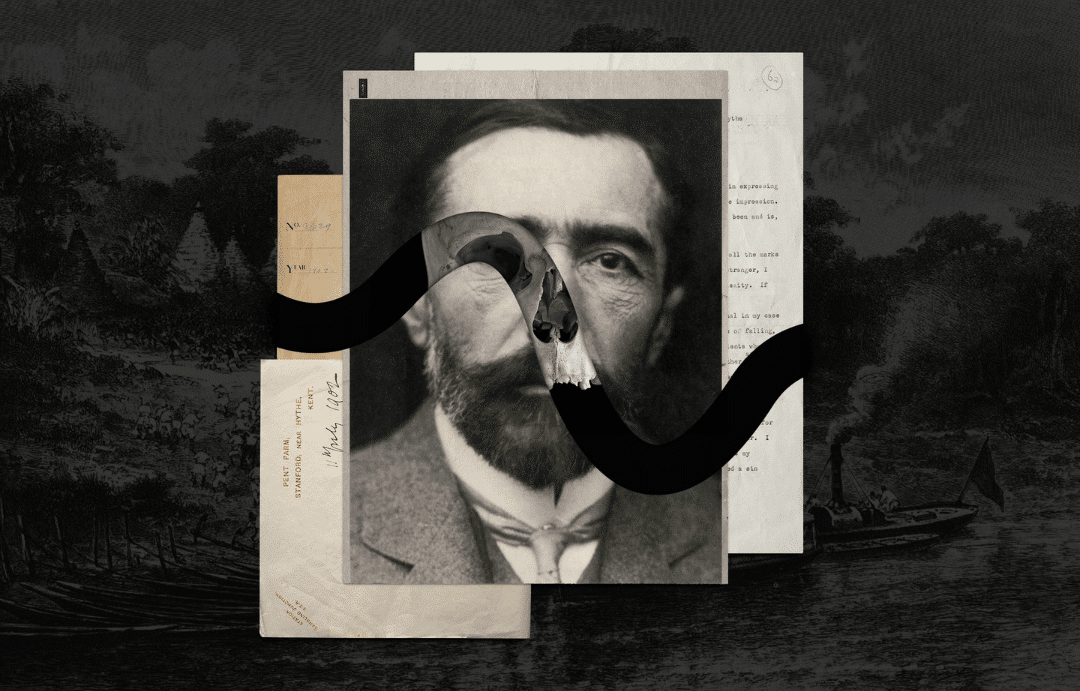
Illustration by Ricardo Tomás
You might also like:
From the Archive: Bram Stoker (1911)
Weeks after the discovery of a previously “lost” Bram Stoker story and on the anniversary of his birth, we’ve taken…
Living by her pen: how the forgotten Gothic writer Regina Maria Roche’s legacy lives on
On International Women’s Day, Samiha Begum reveals the history and influence of this forgotten Gothic writer.
Rarely pure and never simple: examining the case file of Lord Alfred Douglas
Playwright Neil Bartlett takes a look in the RLF Archive to assess the letters of Oscar Wilde’s infamous lover, Lord…