
- Collected
- Article
Rarely pure and never simple: examining the case file of Lord Alfred Douglas
- 22 October, 2025
- Neil Bartlett
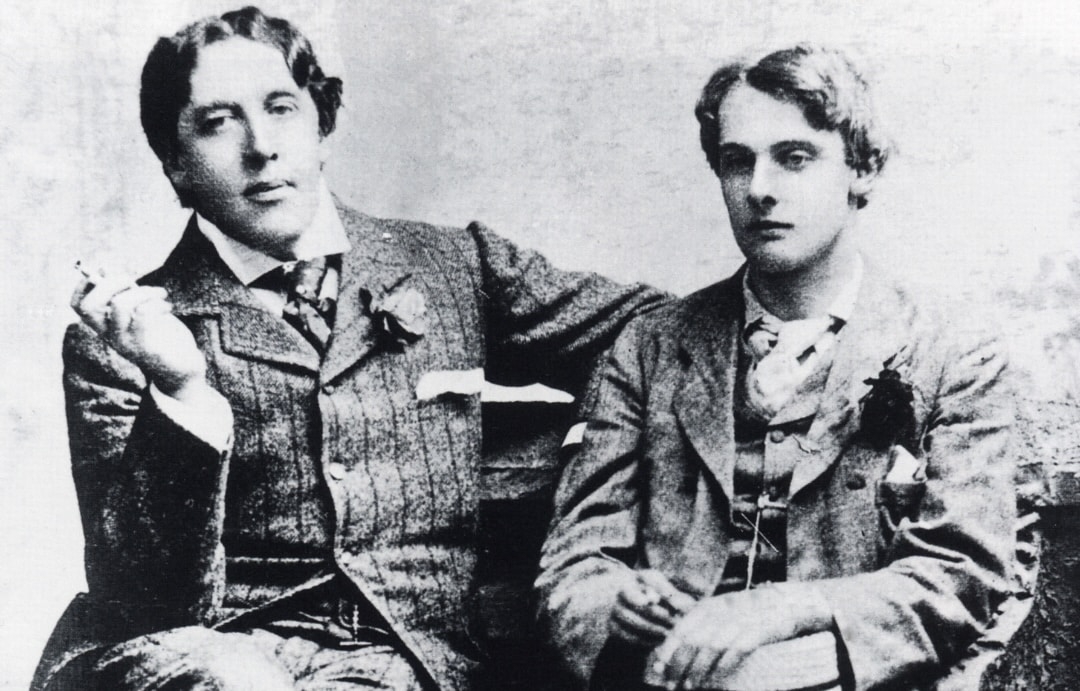
Neil Bartlett has written extensively about Oscar Wilde; in 2016, he gave a marathon solo performance of Wilde’s De Profundis, in the chapel of Reading Gaol, which you can watch online. Here, he takes a look at the letters from Wilde’s former lover, Lord Alfred Douglas – who was born 155 years ago today, 22 October 1870, and is pictured above with Oscar Wilde (© Pictorial Press Ltd, Alamy) – when he wrote to the Royal Literary Fund to apply for a hardship grant in the mid-1940s.
Neil Bartlett
I seem to have been walking in Oscar Wilde’s footsteps all my life. I wrote my first book about him back in 1988, and have directed his work at regular intervals ever since. I even lived for a decade on the very same stretch of English seafront-promenade where he once rented a house for the summer — and used his summer holiday to write The Importance of Being Earnest. Books by and about Wilde – and by and about his lover, the infamous Lord Alfred Douglas – take up nearly four shelves in my study. It is rare for me to be surprised by any documents relating to either of their lives that I haven’t yet heard of. However, in the archive room of the Royal Literary Fund, I was recently shown a whole precious collection of them. Giving me a glimpse of Douglas a whole half-century after he had ceased to be Wilde’s ‘Bosie’, they made me reassess some of my most basic feelings about him.
Almost by definition, the appeals for money held in the archives of the Fund show people at their lowest; the fund only exists to provide relief for those fallen on hard times. Some, however, fall harder than others, and the Fund’s precious handful of Douglas-related documents are evidence of just such a case.
The first document in the Fund’s file on Douglas is a now-fragile copy of the then-standard application form, printed on thin blue paper and dated 7 February 1943. At this point, Douglas was in his middle-seventies, and ought to have been riding high. In the aftermath of the Wilde trials, he had successfully re-invented himself, whitewashing his part in Wilde’s downfall by posing as a married, homophobic and fervently Anglo-Catholic anti-Semite. After a spell in prison as a bankrupt – brought on by a taste for unwise litigation – the next self-aggrandising climb-back involved apologising for both the homophobia and the antisemitism — and trying to cash in on his association with Wilde in a volume of memoirs. By February 1943, he was working hard on being taken seriously as a poet. A new edition of his collected sonnets was due, to be followed up by a well-timed and publicity-garnering attack on TS Eliot. However, the details on the blue RLF application form betray considerably more than Douglas would have wanted anyone to know about the reality behind this latest re-branding.
First off, Douglas reports that he has no means beyond a “small” voluntary allowance from his wife and describes the couple as “married but residing apart”. In fact, he had been bitterly estranged from his wife (the heiress Olive Custance) for a good twenty years. The annuity he received from her was £300; since he was in receipt of another hundred a year from a nephew who paid his rent, he was in fact being subsidised to the tune of the modern equivalent of £25k pa. Douglas also estimates his own literary earnings at £100 pa — so the word ‘small’ as a description of his income is clearly relative.
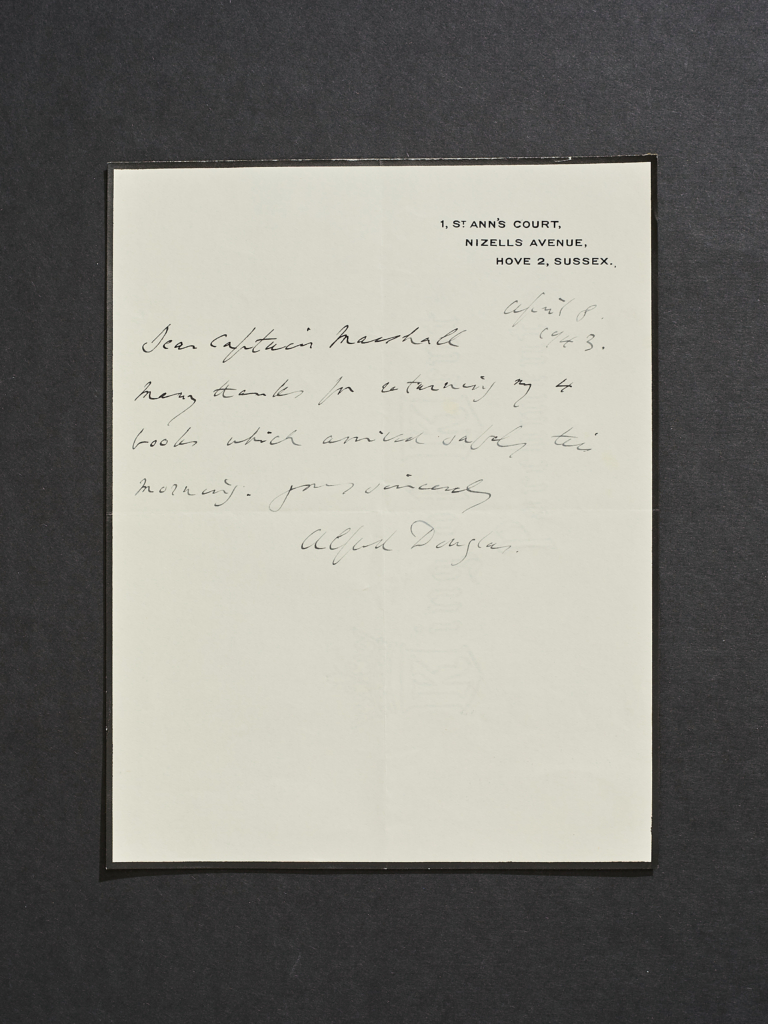
A 1943 letter to the RLF from Lord Alfred Douglas. © All rights and credit go to the owner. No copyright infringement intended.
Context to these figures is given in a supporting letter — from, of all people, Marie Stopes. Stopes was a pioneering sexologist and an early advocate of a woman’s right to control her own fertility. Like Douglas, she was also a full-time controversialist; I suspect it would have been their shared taste for playing with the fire of public opinion that made her offer to pick up the cudgels on her friend’s behalf. In her letter, Stopes lays it on thick. After bewailing the fact that his family have stopped paying the rent, she describes Douglas’s current address in Hove as having “a slip of a dining room, a tiny bedroom and a pretence of a kitchen”; for context, a one-bedroomed flat in the same rather attractive block has just been on the market for £415k. Not entirely shabby, then. The ending of the letter gives us a glimpse of Douglas’s still clearly active ability to mythologise himself as being always wronged and never wrong-doing — and, I think, of Stopes’s own fear of the famous Douglas temper. She requests that the Fund enter no correspondence with Douglas following her letter “as he has had so many disappointments and is so sensitive and frail that he gets easily upset”. She notes that it would be “a national disaster and disgrace if he were to be turned out of his flat… for no creative writer of such sensitiveness can write with the shadow of fear hanging over him”.
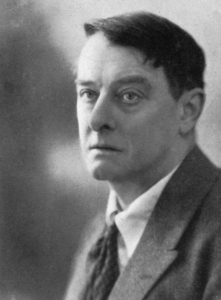
Lord Alfred Douglas, 1929. © Historical Picture Archive, Alamy.
This claim – that after a lifetime of litigation, falsehoods and opportunism Douglas had become a sensitive soul, unable to cope with a mere pretence of a kitchen – clearly worked. Whoever was handing out the money that year decided to overlook Douglas’s backstory in favour of the recent resurgence of his literary ratings, and the Fund sent him £100.
Two years later, Douglas had evidently completely lost control of his finances. On 29 January 1945, he submitted a further appeal, sent this time from Old Monks Farm in Sompting, West Sussex. Just before Christmas, Douglas had moved into the home of Edward and Sheila Colman, a couple of Anglo-Catholics who had appointed themselves his saviour, and he was living on their charity.
The details given on this second blue form seem desperate. In the coldest and hungriest January of the war, Douglas’s literary earnings have now become – he claims – “almost negligible”, and his annuity has shrunk to £160. Perhaps tellingly, the only literary work that he lists in support of this second claim is his 1938 autobiography, Without Apology.
Two weeks later, on 13 February, Douglas tries to strengthen his case by posting a copy of his collected sonnets; on 21 February, he writes again. This letter has been typed for him (presumably by one of the Colmans) and is only very shakily signed; there is a handwritten postscript in which Douglas claims to have forgotten to post it with the book, possibly to give himself an alibi for this extra bit of special pleading. He then goes on to explain the details so baldly summarised on the form; his wife having died, her annuity has become liable to a cripplingly high level of tax. Despite presumably knowing he was unlikely to get a second one-off payment (the Fund’s rules stipulate that such payments could only be repeated after a three-year interval), Douglas seems to be angling for a replacement for his lost annuity. “I was 74 last October,” he writes, clearly hoping to suggest that he was offering a relatively cheap deal “and my expectation of life cannot be more than two years.” As if that were not enough, he adds “I have twice received extreme unction.”
The final, short letter dated 12 March, begs that “a special exception in my favour be made” to the Fund’s fixed timetable for grant-giving. The file then ends with a handwritten postscript: “Please excuse this scrawl. I am dreadfully ill and find it very hard to write, having had a bad night”.
The handwriting of this postscript is as revealing as its wording. It is cramped, fragile — and childish. In these two handwritten lines – almost the last thing that Douglas ever wrote – we see the one-time habitué of the Café Royal and author of that famously grandstanding line about “the love that dares not speak its name’” — attempting one final reinvention, posing now as a fretful and inexpert cadger, trapped in somebody else’s guest bedroom, visited only by priests and nightmares. Right to the end, Douglas seems to be living off rage — a kind of ill-concealed fury that the world has never treated him with the respect that he deserves. As I stared at these last miserable and seemingly self-pitying lines, I found myself wondering all over again what on earth Wilde can have seen in this duplicitous and petty-minded man.
The question, of course, is a foolish one; even a cursory look at any of the surviving photographs taken of Lord Alfred in the year the two men met would provide me with my answer. Beauty like that is incontrovertible. While it is easy to see how Wilde was in some sense destroyed by his lover’s charisma, it is perhaps harder to admit that Douglas must also have been its long-term victim. When you are born with that much power over others, what else can you feel but forever both entitled and disinherited, for ever displaced by your own image? Closing the file, I couldn’t help but be moved by what I’d read. I found myself wondering if the real value of this cache of fading documents was not that they’d confirmed me in my received ideas about a monster, but rather that they’d obliged me to (almost) feel sympathy for him…
Lord Alfred Douglas died on 20 March 1945. He never received a reply to that letter of 12 March, and only twenty people attended his funeral.
Neil Bartlett has been making rule-breaking theatre and performance since 1983. He is also an acclaimed author, with a whole shelf of novels, plays, adaptations and translations to his name. His most recent novel, Address Book, was published by Inkandescent in 2021 – and his very first novel, Ready to Catch Him Should He Fall (1990), has recently been republished by Profile as a Serpents Tail Classic. For more on Neil’s work, you can visit his website here.
If you would like to find out more about the RLF’s extensive history of letters from writers, you can browse our digital catalogue on the RLF Archive site. The RLF Archive is housed at The British Library (for materials up until 1939.)
If you are a writer interested in learning about our hardship grants, find out more here.
This article originally appeared on our Substack.
You might also like:
Banned Books Week: The RLF writers who faced censorship
To mark Index on Censorship’s Banned Books Week, we take a look at the work of five RLF writers who…

The relentless brilliance of Muriel Spark
Lauren J. Joseph on Muriel Spark, who applied to the RLF for a grant in 1950, seven years before the…
Rediscovering Ivy Compton-Burnett
On the 140th anniversary of her birth, Stuart Jeffries revisits one of Britain’s finest but neglected novelists.