
- Collected
- Article
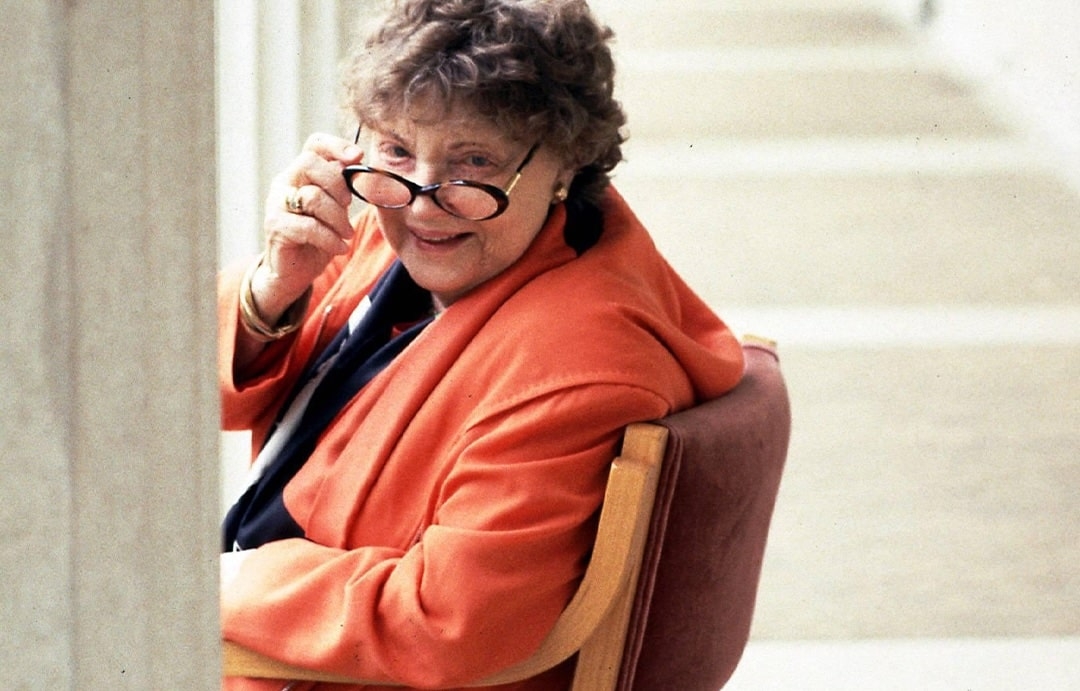
The relentless brilliance of Muriel Spark
- 19 August, 2025
- Lauren J Joseph
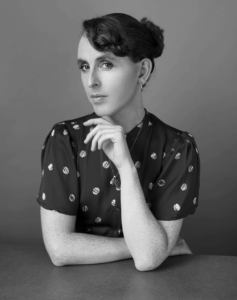
Lauren J Joseph by Eivind Hansen
Lauren J. Joseph, who begins her RLF Fellowship this coming September, recently took a look through our archives to find novelist Muriel Spark’s 1950 letters to the RLF and reflect on a quality many writers have to develop – the “sheer bloody-mindedness” Spark had in spades.
Muriel Spark has been dead for almost twenty years, something I’m sure she would consider to be quite an achievement. Twenty years on the job, surely that deserves a raise?
Being dead is an impossibility of course, an absurd contradiction, a wicked little paradox of the kind Spark herself relished. Truly her work brims with such inversions of accepted logic. She consistently stands narratives on their heads, she has stories narrated by ghosts, and protagonists who seem to believe they’re writing the other characters with whom they share the page. The outcome of all this is a body of work singularly bleak and uproarious. Who else could’ve concocted such a genuinely sinister plot (blackmail, poison and corruption) spiked with such silly vignettes (a grand dame wetting her knickers to save the day) as that which Spark gave us in Loitering with Intent?
In addition to biographies, short stories, and poetry, Spark wrote twenty-two novels. Admittedly they’re slim volumes but that is still an astonishing figure. A handful of these books have been adapted as movies starring Glenda Jackson, Elizabeth Taylor and most famously, Maggie Smith. Indeed it’s fair to say that for many people the mention of Spark will summon up Smith’s Jean Brodie, rather than her creator’s words on the page. Spark herself spoke of her conflicting feelings towards this, her first big success. It overshadowed much of her later work, she said. Undoubtedly the creme de la creme of it all goes someway to explain the erroneous understanding of Spark today, as a writer of light comedies, whilst the exaggerated and overlapping scandals of her personal life would frame her as a bad mother, closet lesbian, and insufferable diva.
These readings combine quite unfortunately to obscure Spark’s talent, and a legacy in which her bleak and really quite perverse stories cut shockingly against her received persona as kooky old bohemian. Or perhaps it’s more accurate to say that the one acts as brilliant foil for the other? Certainly the two form a ongoing mise en abyme, with abstract details of her biography appearing in her novels, and characters from her novels sauntering out into her memoirs. The happenings in A Far Cry from Kensington for example, are not a million miles away from Spark’s own early experiences in publishing as an editor. Likewise Frances Wilson’s recent biography Electric Spark explains that the central motif of transmitters and hidden recording devices in Spark’s The Abbess of Crewe have unsettling parallels with the author’s real life paranoias – including one sorry episode in which she became convinced that she’d stolen a plot from T.S. Elliot, delivered to her via a form of leaky telepathy over the wireless.
I myself am not a biographer and so I’m not looking to find any essential truths about Spark as a woman or as an artist. What I would like to do in the space afforded me here is to celebrate her for a quality which is usually overlooked. Sheer bloodymindedness, a characteristic more often attributed to actresses than novelists.
Spark applied to the RLF for a grant in 1950. She was desperate and she was unsuccessful with her application. This is not because her work was of poor quality, but rather because she hadn’t put enough of it out in the world to meet the criteria. Really the only thing she had on the shelves at the time was “A Tribute to Wordsworth” , a collection of essays she’d co-edited, so her work as a writer was limited to what the RLF class as “contributions”.
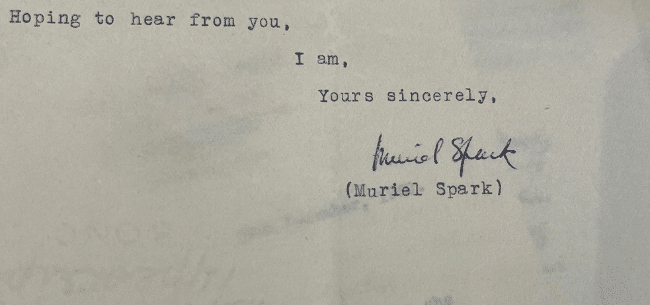
Muriel Spark’s signature, shown on one of her letters to the RLF.
Spark was thirty-two at the time, she’d worked in intelligence during the war, she’d been married and divorced and given birth to a child, she’d written criticism and edited the Poetry Review for a year, she’d been plenty busy. She had not however published her first novel. That book, The Comforters, wouldn’t come for another seven years.
Spark’s recurring professional tragedy at the time of her application was that she had been repeatedly contracted to write books by publishers who then promptly went under. Though it may sound like a plot of her own devising nevertheless this sorry situation actually befell her with no fewer than four titles; a biography of the Brontës, an introduction to Anne Brontë’s collected works, a biography of Mary Wollstonecraft Shelley, and a collection of Shelley’s letters. In each case she had undertaken large chunks of the work, and in some cases completed it. She didn’t ever receive more than her first payment. When she wrote to the RLF asking for support she offered to provide a letter from her doctor detailing just how ill these successive disasters had made her. It did her no good, her request was turned down and she did not reapply again. Had she done so a few years later, with a healthier body of work, I’m assured she surely would’ve been successful. So please, if you’re a professional writer in need, do apply!
When one considers what it was to be a woman, divorced and working freelance in 1950, it hardly seems believable that Spark found the wherewithal to go on writing after this rejection. She was not born into a wealthy family, she suffered debilitating mental health issues, and she subsisted for long stretches on jacket potatoes and beans. But continue with her work she did. “I’m a writing animal, I write just in the same way as cows eat grass,” as she told BBC Radio in 1970. There was no other way for her to live. I am not here to say that all a career in letters requires is tenacity and a can-do attitude, but rather that knowing the challenges Spark overcame makes me doubly grateful for her.
Her biography should also serve to make us aware of the great many talented writers who are struggling today against the economic inequality which all but defines our cultural landscape. Everyone who loves literature loses out in a situation where only a lucky few have the resources to write with the consistency necessary to hone a talent and build a readership. Likewise authors themselves need to reevaluate their own misconception of writers as very special geniuses, somehow outside of the workforce, and acknowledge that they are in fact labourers in need of collective organisation and action. As writers we are called to be both nun secluded and grand dame a-rampaging, and that is a very Sparkean mode of being indeed.
This article originally appeared on our Substack.
You might also like:
70 fascinating facts you might not know about the Royal Literary Fund
To celebrate our 235th birthday on 18th May, we’ve put together a selection of fascinating facts about the RLF from…
Inform, educate and entertain – the story behind BBC Radio 3
2025 Tinniswood Award judge and RLF Fellow Nicola Baldwin on the battle for Britain’s “National Theatre of the airwaves.”
Making the work invisible: Trish Cooke on Alterations
RLF Fellow Trish Cooke on adapting Michael Abbensetts’ 1978 Windrush era play Alterations for the National Theatre.