- RLF News
- Article
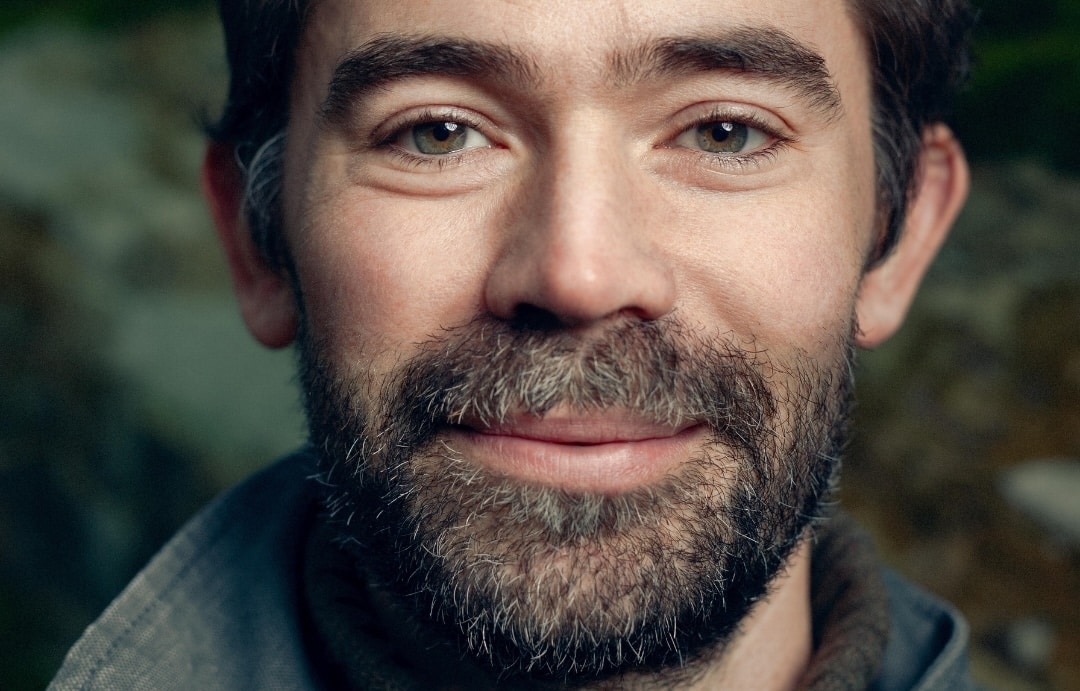
My Writing Life: Adam Weymouth
- 25 August, 2025
Adam Weymouth is a writer and journalist living on the south east coast of England. A former RLF JB Priestley Award recipient, his first book, Kings of the Yukon, tells the story of a five month canoe trip across Canada and Alaska, examining the decline of the king salmon. His new book, Lone Wolf, follows a thousand miles in the footsteps of the first wolf to return to the Italian Alps for more than a hundred years. He has been named by the National Centre for Writing as one of ten writers shaping the UK’s future.
1. What book should every writer read?
For my money it’s the Border Trilogy by Cormac McCarthy – it’s as close to perfection as anything gets.
2. What is your typical writing day like?
I’ll drop the kids off at school and then cycle along the coast to Margate, where I’ve got an office space. There a small bunch of other writers there, and it’s nice to have some sense of colleagues. If work’s going well and the tide is right I might go for a swim at lunch, although not as often as I should. I find the writing days a challenge. But then I get to go out on these journeys and get a window into peoples lives, and it feels like the best job in the world.
3. Who has been an influential figure in your writing career?
None more so than my English teacher, Simon Hill, who taught me when I was maybe 9 or 10. I always wanted to write, but if there was a teacher who made me passionate about words and stories it was him. I still remember his infectious enthusiasm now. It gave me huge pleasure to get in touch with him to thank him when I published my first book.
4. What is the one thing you wish someone had told you before you started your career as a professional writer?
That it isn’t quite as consistently romantic and thrilling as the writers I grew up on – Jack Kerouac, Dylan Thomas, Bruce Chatwin – had led me to believe. But then I might never have embarked on it in the first place.
5. What is the best advice you’ve ever received about your writing?
It’s so hard to single something out – it is more an accumulation of the many wise and patient editors I’ve worked with over the years, who have helped me hammer out structures, be more precise and more curious, and to avoid fudged, half-formed thinking. Learning how to graciously accept good editing is one of the most important skills of all.
6. What has been the proudest moment of your career so far?
Winning the Sunday Times Young Writer of the Year, back when I was still young. To say I was stunned does not come close. There were past winners on that list – William Fiennes, Robert Macfarlane, Zadie Smith – who I’d been hugely inspired by. The award made me think of myself as a writer, rather than someone just trying it out – although it didn’t make writing the next one any easier.
7. What are you reading right now?
Jay Griffith’s new book, How Animals Heal Us. She’s a marvellous writer who I was inspired by for many years, before getting to know her on an Arvon course recently. By some curious alignment, we’ve both written books about animals that are coming out in the same week. It’s a wonderful book about the vitality of animals and their power to animate us, written in the remarkable way she has of getting right inside your mind.
8. Bookmarker or page-folder?
I didn’t even know there were page-folders until I met my wife.
This article originally appeared on our Substack.
You might also like:
My Writing Life: Lisa Parry
“It’s so important to take the time to make a script the best it can be before letting anyone else…
My Writing Life: Eric Ngalle Charles
“The best advice I ever received about my writing? – ‘Eric, this is crap.'” – poet, author and RLF grants…
My Writing Life: Annie Siddons
“If you desire stability, holidays, nice stuff, and not being poleaxed by anxiety, choose another career.” – Annie Siddons