
- Collected
- Article
Ashdown Forest – exploring the real Hundred Acre Wood
- 8 June, 2026
- Sanjida O’Connell
As we celebrate 100 years of Winnie-the-Pooh, award-winning writer and trained zoologist Dr Sanjida O’Connell (who also writes fiction as Sanjida Kay) took a trip to Ashdown Forest, the ancient landscape that inspired author AA Milne to create Winnie-the-Pooh’s home – the Hundred Acre Wood, which takes its name from Ashdown’s own Five Hundred Acre Wood.
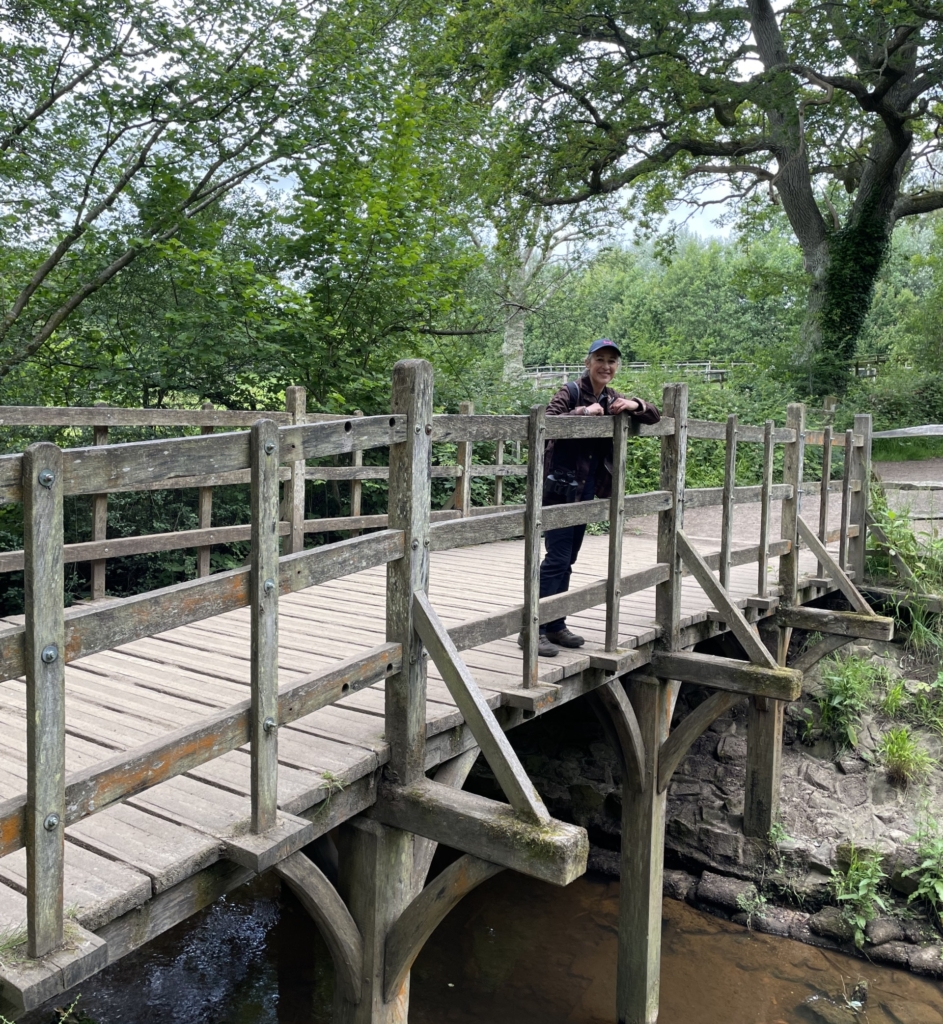
Sanjida O’Connell stands on Pooh Sticks Bridge – real name Posingford Bridge – in Ashdown Forest
The sound drifting towards me on the soft summer air is mechanical, a whirring and clicking, as if an automaton lurks in the woods below. I wait until I see it: and for a brief moment he’s there, cruciform against the smudged indigo of the darkening sky. A male nightjar churring at dusk, warning intruders that this is his and his mate’s territory. Nightjars, or fern owls as they were once known, are superbly camouflaged visitors from Africa, who hide by day and emerge at dusk and dawn. And this pair are nesting in a truly enchanted spot: Ashdown Forest, the landscape that inspired one of the world’s most loved children’s stories: Winnie-the-Pooh.
This year, 2026, marks 100 years since the first Winnie-the-Pooh book was published. After his death, the author, AA Milne, left a portion of his Winnie-the-Pooh royalties to the Royal Literary Fund as a legacy to support writers. I’m here as a writer who has been supported by the RLF to visit the places described in Milne’s books and poems, which have inspired generations of readers. And as a trained zoologist and rewilder, I’d like to see how these famous fictional spots, from The Hundred Acre Wood to the Heffalump Trap, have become a haven for wildlife.
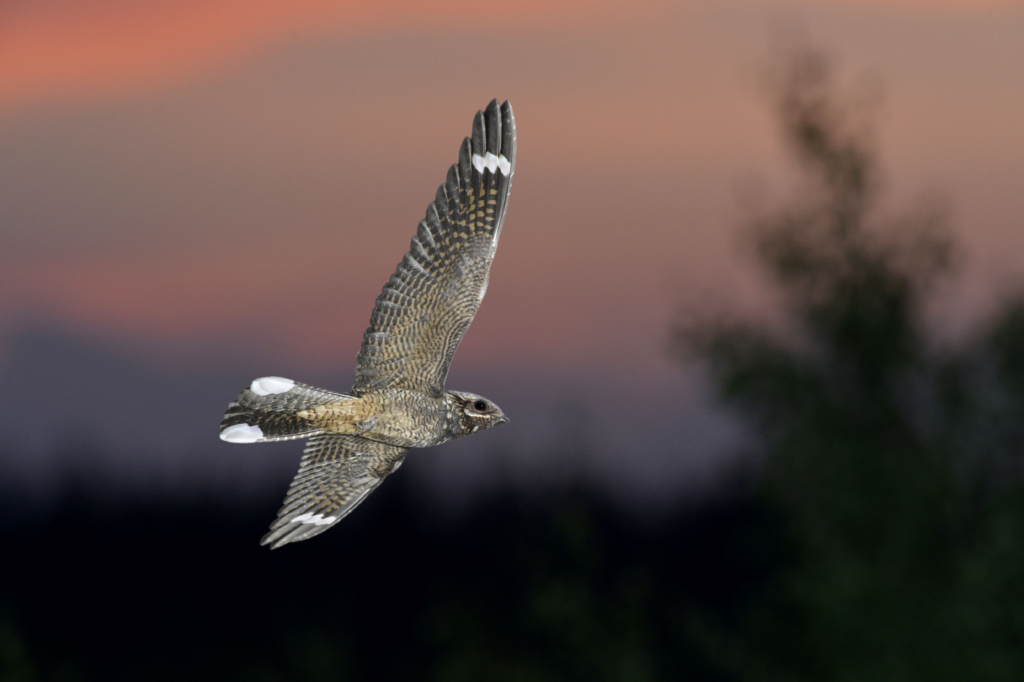
The Nightjar Caprimulgus europaeus © Alamy.
Where I’m standing right now, watching the nightjar pair, is a steep-sided sandy heath. The first heather buds are beginning to show, pale and pink and pointed as ballet shoes; the scent of gorse is toasted coconut. All around me are heath-spotted orchids; tutus of taffeta-pink and burnt-magenta. Ashdown Forest is one of the largest open access-areas in south-east England. Two-thirds of its 6,500 acres is heathland, habitat rarer than a tropical rainforest and home to some of Europe’s most threatened species. And even though over 1.5 million visitors come here — it’s only 30 miles from London — it’s a Site of Special Scientific Interest. Here you’ll find exquisite fauna and flora, from Dartford warblers to silver-studded blue butterflies to lesser butterfly-orchids.
Milne moved here, buying Cotchford Farm on the edge of the Forest, in East Sussex, in 1925. “Cotchford took possession of us,” wrote his son, Christopher Milne in his memoir, The Enchanted Places. The surrounding jungle, fields, woods and streams became “the site of so many small adventures and happy memories”. It was here that Christopher, who was five when they moved, had adventures with his toys: his bear, Winnie-the-Pooh, Piglet and Eeyore. Perhaps because Milne was not good with children, according to Christopher, but was desperate to connect with his son, he started to tell him stories. As Christopher wrote:
My father was a creative writer and so it was precisely because he was not able to play with his small son that his longings sought and found satisfaction in another direction. He wrote about him instead.
Christopher Robin Milne, The Enchanted Places.
Ash Walmsley, Head of Countryside for Ashdown Forest, gives me an insider’s guided tour. We visit Galleon’s Lap, Gill’s Lap Clump and Roo’s Sandy Pit, a disused quarry where baby Roo played before the other toys kidnapped him. I see Dartford warblers, singing on briars, male stonechats with their bracken-rusted breasts; skylarks soar overhead just as they did when Henry VIII hunted here and battles were waged over commoners’ rights to graze.
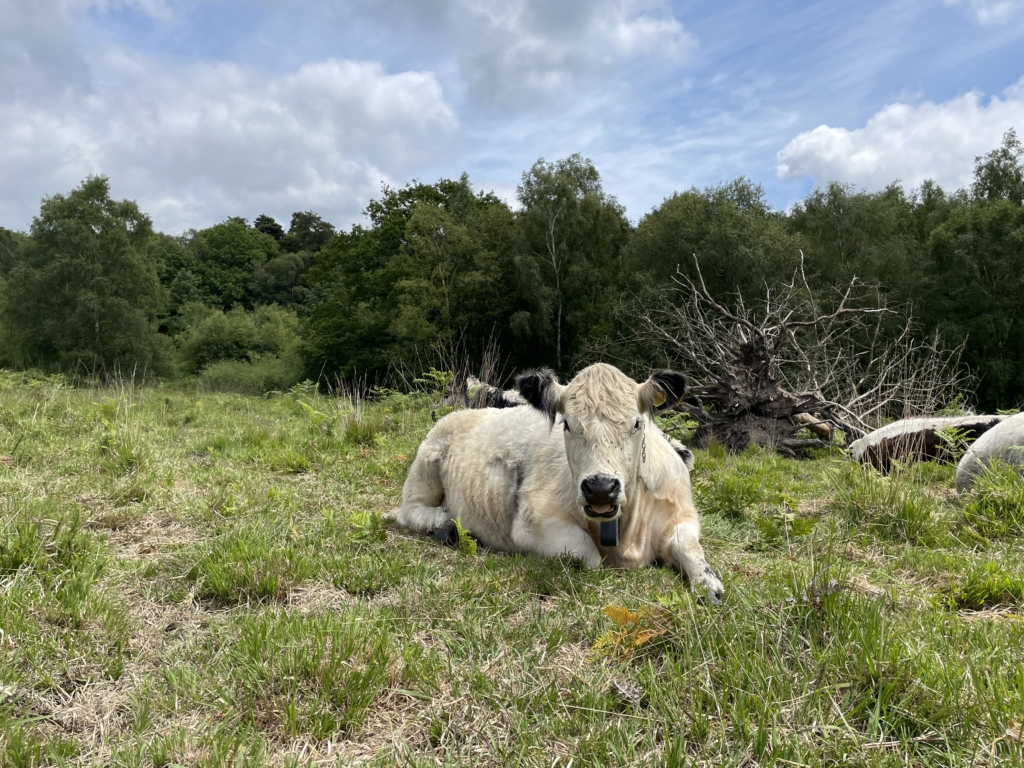
‘Riggit’ Galloway cattle are usually identifiable by the white stripe running down their spine. © Sanjida O’Connell.
Ash takes me to see the herds of wild Exmoor ponies and gentle, cream-coloured ‘riggit’ Galloway cattle, which are stopping the furze and the scrub from taking over and are maintaining the Forest as a mosaic of open moorland with pockets of deciduous woodland.
We can’t leave, of course, without visiting Poohsticks Bridge, in Posingford Wood. Christopher used to come here to throw sticks over one side and watch them from the other as they floated awaydownstream. The moss-coated bridge spanning tea-brown water looks much as it did when EH Shepard first illustrated the Winnie-the-Pooh tales, although, thanks to the huge numbers of visitors trampling over it, it has had to be rebuilt twice.
“It is difficult to be sure which came first,” wrote Christopher. “Did I do something? And did my father then write a story around it? Or was it the other way about, and did the story come first? Certainly my father was on the lookout for ideas; but so too was I. He wanted ideas for his stories, I wanted them for my games, and each looked towards the other for inspiration.” He couldn’t recall whether, as a child he visited the bridge before or after his father’s story of it, but concluded:
In the end it was all the same: the stories became a part of our lives; we lived them, thought them, spoke to them.
Christopher Robin Milne, The Enchanted Places.
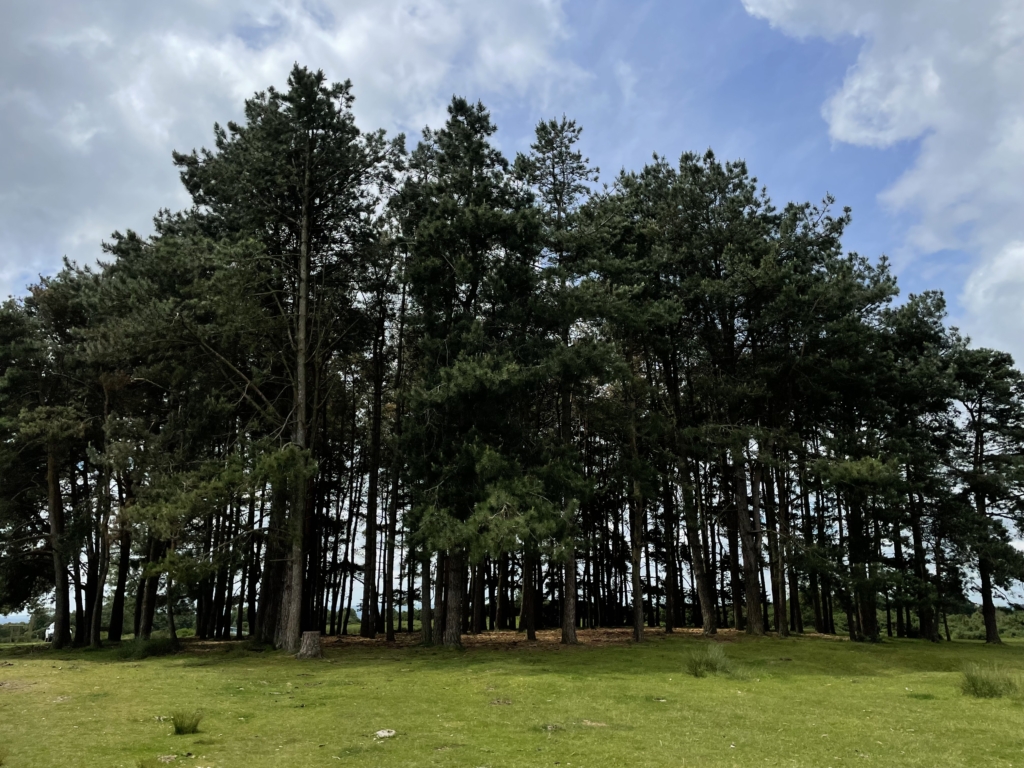
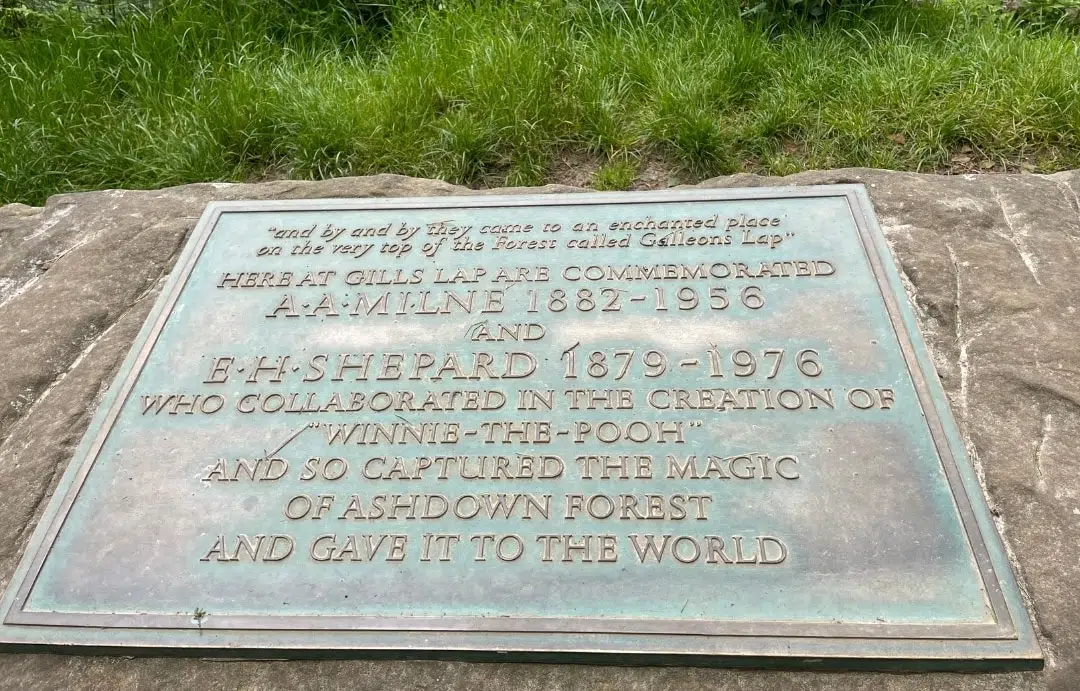
Gill’s Lap Clump © Sanjida O’Connell.
This article originally appeared on our Substack.
You might also like:

70 fascinating facts you might not know about the Royal Literary Fund
To celebrate our 235th birthday on 18th May, we’ve put together a selection of fascinating facts about the RLF from…
Enter the Ashdown Forest poetry competition 2026
Entries are now open for the third annual Ashdown Forest poetry competition, in partnership with the Royal Literary Fund.
Passing on the pen: a writer’s legacy
Writers AA Milne and Arthur Ransome share a birthday – and they both donated a portion of their estate to…