
- RLF News
- Article
From stage to page: the creative life of Noel Streatfeild
- 17 November, 2025
The correspondence in Noel Streatfeild’s RLF file includes a typewritten list of her books – one accompanying note estimates there are “over 50!”, although the actual number is 65.
Each book in the list is identified by title and date, beginning with her first, The Whicharts (1931) and ending with More About The Maitlands, which was published the same year the RLF file begins, in 1979. But even this typewritten book list does not seem definitive: Persephone Books, which recently reissued Streatfeild’s Saplings (originally published in 1945), describes her as having written “over 80 books, as well as three volumes of autobiography” in her lifetime.
As such a prolific and hugely talented writer, Streatfeild – who received financial assistance from the RLF in the latter years of her life – created some of literature’s most beloved characters. She is probably best remembered as the author of Ballet Shoes, which was first published in 1936 and continues to attract new fans almost a century later: this week sees the National Theatre’s production of Ballet Shoes, directed by Katy Rudd based on an adaptation by playwright Kendall Feaver, return for a second Christmas season, after a much-acclaimed run at the National’s Olivier Theatre in 2024.
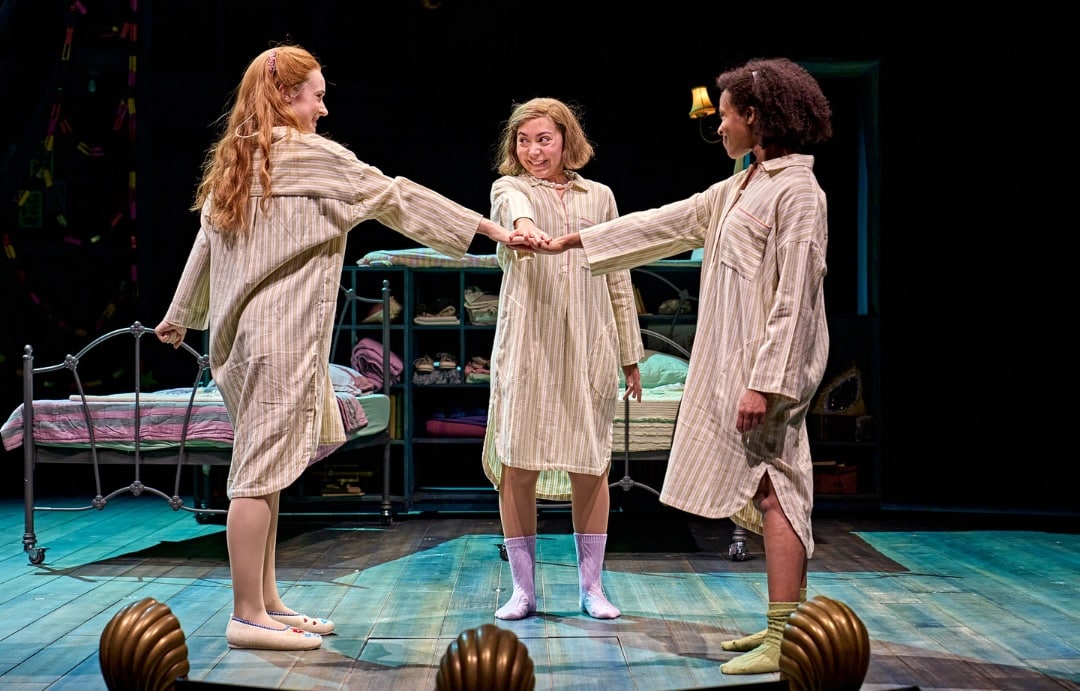
Daisy Sequerra (Posy Fossil), Yanexi Enriquez (Petrova Fossil) and Grace Saif (Pauline Fossil) in Ballet Shoes at the National Theatre, 2024. © Manuel Harlan
Ballet Shoes, which follows the lives and ambitions of adopted sisters Pauline, Petrova and Posy Fossil, was Streatfeild’s first book for children. According to several sources – including Streatfeild’s own fictionalised biography series – it came about because, having previously written adult fiction centred around themes of found-families and stage school dynamics, Streatfeild was approached by a publisher and asked to write something aimed at a younger audience. She turned to her very first book, The Whicharts, for inspiration. As a result, there is a lot of crossover between The Whicharts and Ballet Shoes: both feature three sisters who pursue careers onstage to help finance their own and their guardians’ lives, and, in the process, each discovers a specific talent that becomes a burning ambition. But having been written for an adult audience, The Whicharts is much darker in tone. The lives of the Fossil sisters in Ballet Shoes may be precarious, but they also have warmth and a certain glamour which is lacking in The Whicharts. It is certainly much franker about the difficult and often murky reality of making a living in the performing arts.
Streatfeild had first-hand experience of that reality, having trained as an actress at the Royal Academy of Dramatic Art. She also spent a decade working on the London stage in the 1920s, all of which informed much of her later writing. As a result, her books about children trying to follow their dreams – whether as ballerinas, actresses, engineers or ice skaters – feel authentic and unsentimental.
I started my adult career as an actress which is, of course, a most disciplined life…
Noel Streatfeild, Women Journalist
Young readers responded to that authenticity right away. The first edition of Ballet Shoes, which featured illustrations by Streatfeild’s own sister, Ruth Gervis, was an instant bestseller and nominated for the first-ever Carnegie Medal for Children’s Literature. Although it didn’t win, Streatfeild did receive the Carnegie Medal in 1938 for The Circus Is Coming, another classic tale of children working towards a career in the performing arts, this time in a circus tent.
Ballet Shoes also proved so popular that many of Streatfeild’s subsequent children’s novels were later renamed by her American publisher to capitalise on its success. So The Circus Is Coming became Circus Shoes; Curtain Up (1944) – which features a cameo from the three Fossil sisters – became Theatre Shoes; The Painted Garden (1949) became Movie Shoes; and White Boots, which was published nearly 20 years after Ballet Shoes, became Skating Shoes.
The technique worked well enough that the entire Shoes series received a mention by the main character Kathleen Kelly (played by Meg Ryan) in 1998 rom-com You’ve Got Mail, written and directed by Nora Ephron, herself a Streatfeild fan:
Noel Streatfeild wrote Ballet Shoes and Dancing Shoes and Skating Shoes and Theatre Shoes…I’d start with Ballet Shoes first, it’s my favourite. Although Skating Shoes is completely wonderful…and it’s out of print.
Kathleen Kelly in You’ve Got Mail, 1998
The popularity of Ballet Shoes in particular continues to endure. There have been a number of adaptations since the book’s initial publication, including a 1975 film version, a 2007 BBC TV adaptation starring Emma Watson as Pauline, numerous radio plays, and this year’s National Theatre production, which sees Sienna Arif-Knights, Nina Cassells and Scarlett Monahan play the three Fossil sisters.
And yet Streatfeild was taken aback by the book’s success. In Away From the Vicarage, one of her three books of fictionalised biography, she said:
Everybody seemed to be writing about the book and with so much praise…You’d think I had written the Bible.
Noel Streatfeild on Ballet Shoes
But she seems to have taken it in her stride, as the non-exhaustive list in her RLF file shows. Having 65 books published in 48 years required a great deal of discipline, which saw Streatfeild once again look back to her earlier acting training:
“I find the physical effort of writing hard,” she wrote in 1960 for a piece published in the magazine Woman Journalist. “I started my adult career as an actress which is, of course, a most disciplined life… When, therefore, in 1930 I sat down alone with sheets of paper in front of me to write my first novel it was an appalling effort to discipline myself to work.” Within a few months, though, she had found the answer: “My method is simple. I write in bed.” She would stay in bed until the day’s writing was done, only getting dressed when she was finished.
In the latter years of Streatfeild’s life, letters from her nephew William Streatfeild demonstrate she was still writing between periods of ill-health. After her death in 1986, a number of short stories were discovered among her papers. Donna Coonan, then-editorial director of Virago Modern Classics, told The Guardian she could “hardly believe what gems there were” when William invited her to have a look.
And in among the notes, drafts and short stories, there were also letters from readers. When Streatfeild’s papers were donated by her nephew to the Seven Stories Museum in Newcastle, they discovered a treasure trove of fan mail, dating from the 1930s right up until 2003.
That her stories still resonate today, nearly 90 years after Ballet Shoes was first published, is testament to their enduring and timeless appeal.
To find out more about the RLF’s range of hardship grants, take a look here.
This article originally appeared on our Substack.
You might also like:
From the Archive: Bram Stoker (1911)
Weeks after the discovery of a previously “lost” Bram Stoker story and on the anniversary of his birth, we’ve taken…
Making the work invisible: Trish Cooke on Alterations
RLF Fellow Trish Cooke on adapting Michael Abbensetts’ 1978 Windrush era play Alterations for the National Theatre.
Living by her pen: how the forgotten Gothic writer Regina Maria Roche’s legacy lives on
On International Women’s Day, Samiha Begum reveals the history and influence of this forgotten Gothic writer.