
- Collected
- Article
Telling other people’s stories: a writers’ responsibility
- 19 November, 2025
Adam Weymouth’s first book Kings of the Yukon, which told the story of his 2000 mile canoe trip down the Yukon River through Canada and Alaska in pursuit of declining king salmon populations, won The Sunday Times Young Writer of the Year Award.
His newest book, Lone Wolf: Walking the faultlines of Europe, sees Weymouth follow in the footsteps of a young wolf named Slavc, from the Slovenian Alps and through northern Italy to the Lessinian plateau. Lone Wolf has recently been shortlisted for the Baillie Gifford Prize for Non-Fiction.
Having spent years immersing himself in the stories of places and their people, Adam reflects on the writers’ responsibility to the subjects of their story.
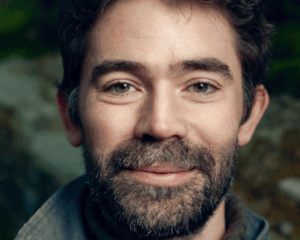
Adam Weymouth
In 2016 I paddled the Yukon River from its source in Canada, through Alaska, to where it meets the Bering Sea. I was writing my first book, Kings of the Yukon, looking at the disappearance of the king salmon and how their crash was changing the lives of the many, mostly Indigenous people who depended on them.
I had been in Alaska once before as a journalist, documenting stories of climate change and resource extraction. On that first trip, I had become quite accustomed to catching an eight-seater plane into some remote community, doing some interviews, and flying out again. People watched me from their front stoops, and each day I would force myself out of my hotel room to go and speak with them. I discovered there was a long and terrible legacy of white folk arriving here, a lineage that ran from whalers through to missionaries, to teachers, journalists and cops. Everyone turning up to take something and leaving nothing – or much worse – in return.
When I returned to Alaska, I resolved to try and do things better. A few years previously, I had spent a year walking from England to Istanbul. On that journey, I had found that moving slowly and paying close attention to chance encounters could afford insights into people and places that I missed when working to a schedule. Following strings of coincidence, choosing the most enticing path and making time to listen opened up angles on complex questions that otherwise got lost. One of the reasons for travelling the Yukon by canoe was to take the time to engage people on their own terms, on their own river. But I had not been prepared for the level of engagement that would be demanded of me on the Canadian side of the border.
Teslin was the first village on the Yukon. The Tlingit tribe who lived there had stopped fishing for king salmon 20 years earlier, when their elders told them the fish were in trouble. What they had to say was integral to my story, yet I was told I could not just show up there and chat to people. All requests for interviews had to go through the proper channels.
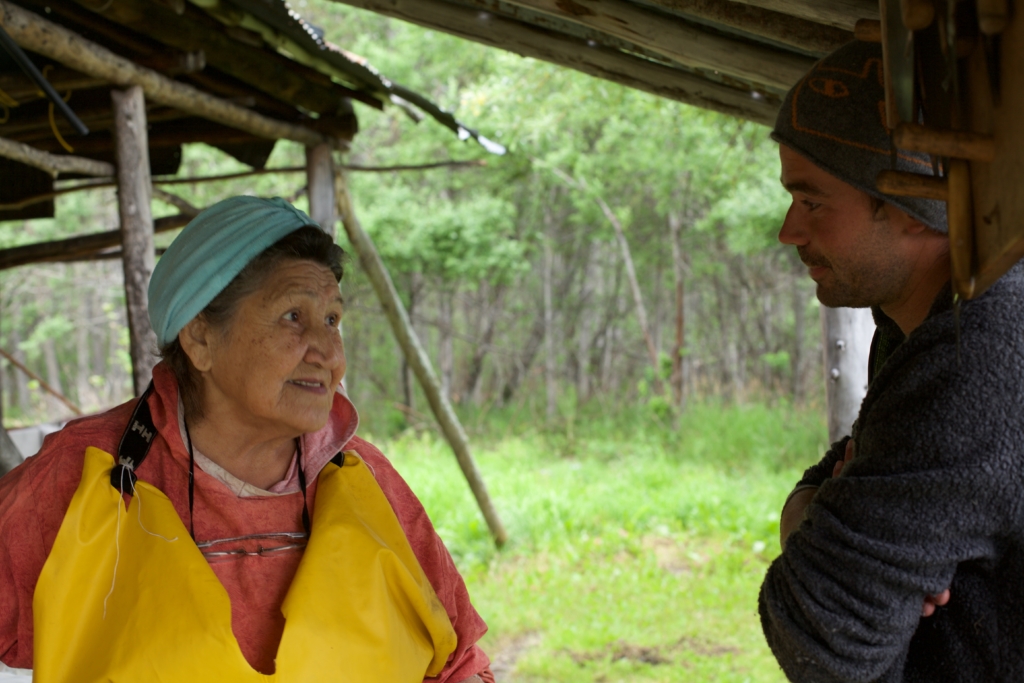
Adam Weymouth in discussion with Mary Demientieff, an Athabascan elder. Photo by Ulli Mattsson.
Since the mid-nineties, Canada has been shifting greater powers of self-governance to First Nations, including having a better say over how their Traditional Knowledge is used. An ethics guide from the Assembly of First Nations calls the co-opting of knowledge ‘another form of colonisation and exploitation’ – in other words, another form of taking.
I was passed from department to department. Email chains went dead, to be picked up by someone else months later. I would call an elder to explain my project and never hear from them again. For someone trying to get a story on a schedule, the whole process was, I’m not going to lie, deeply frustrating. It took a year to organise, but in 2017, I returned to Teslin having already filled out numerous forms to explain my project. Once there I had to fill out further forms before each interview, agreeing on how I would use what I was told. Members of the tribal council sat in on those interviews. I agreed to send them everything I wrote about them for comment before we went to publication. I also agreed to send them copies of the book when it was out. At the time, it all felt quite extraordinary, but of course, what worked for me was not the point at all. The point was to recognise that these stories had a value and were to be honoured, and their retelling should benefit those who gave them, not just me, who wrote them down. The point was that it is impossible to understand the land without doing justice to the stories of those who live there. So the question I left Teslin with was – why should we wait until such honouring of stories becomes written into a legal constitution?
It is impossible to understand the land without doing justice to the stories of those who live there.
It is a philosophy that I have attempted to maintain throughout my work. My new book, Lone Wolf, follows the journey of a wolf who, in 2011, walked a thousand miles from Slovenia to Italy, going on to form the first wolf pack in northeast Italy for more than a century. Tagged by a GPS collar, there is a map of his whole route, and so a decade on, I walked the same path. I wanted to examine the wolf’s remarkable resurgence in Europe, and I wanted to see how those living alongside it once more – the shepherds and the hunters – were coping with its presence. But I also wondered what following this wolf’s journey could tell me about other changes that are now happening in Europe. The climate crisis, rural depopulation, immigration, shifting cultures: I was drawn to this wolf because he had carved a path through Europe’s mountainous hinterlands, and through some of the places that were feeling these changes most acutely. Travelling slowly, following a path not of my making, felt like an important, alternative way for me to give voice to these often-overlooked realities. The polarisations in these places – between urban and rural; between farmer and conservationist; between right and left – can feel intractable. Listening carefully to the stories is a crucial step towards attempting to alleviate these tensions.
During my first visit to Alaska, poking around in Valdez Library, where I found not a shelf, not a stack, but an entire room of books about Alaska, written exclusively by Alaskans. For a state with the same population as Leeds, this was impressive. It was also demoralising. Who was I, I thought, to come here and write about this place? It is a question I still wrestle with today. Mostly I believe that there is merit in an outsider’s perspective, particularly when navigating conflicting ideologies. But what I am now certain of is that no place can truly be understood until the stories of those who are grounded in it are honestly and generously told.
Adam Weymouth is a writer and journalist living on the south-east coast of England. A former RLF JB Priestley Award recipient, his work has appeared in a wide variety of newspapers and magazines, including The Guardian, The BBC, The Atlantic and Granta. His first book, Kings of the Yukon (Penguin, 2018), tells the story of a five-month canoe trip across Canada and Alaska, examining the decline of the king salmon and how that decline is impacting the many communities and the ecosystems which depend on it. The book won the Sunday Times Young Writer of the Year, the Lonely Planet/ Stanfords Adventure Travel Book of the Year and the Prix Paul-Emile Victor. His new book, Lone Wolf (Penguin, 2025), follows a thousand miles in the footsteps of a wolf who crossed the Alps to become the first wolf back in the Italian Alps for more than a hundred years. He has been named by the National Centre for Writing as one of ten writers shaping the UK’s future.
This article originally appeared on our Substack.
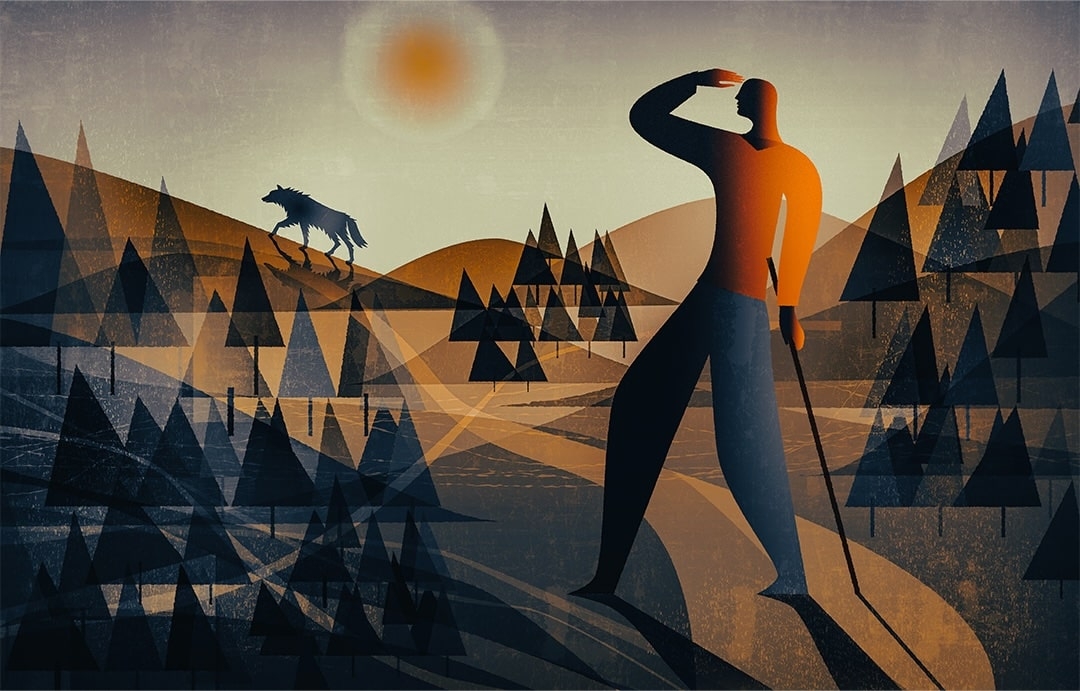
© Illustration by Paul Wearing.
You might also like:

Confessions of a Ghostwriter
An RLF Fellow confesses – anonymously – what it is like to ghostwrite fiction, non-fiction and memoir for celebrities and…
How returning to Nigeria turned Oladipo Agboluaje into a storyteller
“There are two ways to lose oneself: by segregation in the particular or by dilution in the ‘universal’.” — Aimé…

No beach reads here – Summer Trends with Caroline Sanderson
In her final seasonal trends update, Caroline Sanderson looks at what we can expect from the publishing industry this summer…