
- RLF News
- Article
Now we are 100: Six things you might not know about AA Milne’s Winnie-the-Pooh stories
- 14 October, 2026
You may have noticed a certain “silly old bear” is celebrating a great old age this year. Yes, AA Milne’s Winnie-the-Pooh turns 100 today, 14 October 2026, and the celebrations have been keeping us very busy. In July, our Royal Patron Her Majesty The Queen, joined us in Ashdown Forest for a game of Pooh Sticks and this week, BBC Radio 4 is marking the anniversary with a special week of programming, including Save the Hundred Acre Wood, a new play by our Chief Executive, dramaturg Edward Kemp, which will be broadcast on Saturday 17 October.
But when Milne’s very first Winnie-the-Pooh story, The Wrong Sort of Bees, was first published in the London Evening News on Christmas Eve in 1925, nobody could have predicted we would still be celebrating him a century later.
So, in honour of our favourite “bear of little brain” and his special big birthday, here’s six things you may not know about the Winnie-the-Pooh stories.
© E. H. Shepard LLP / The Estate of E. H. Shepard
One: The origins of Edward Bear
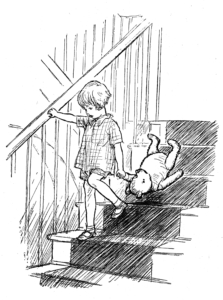
He may now be recognisable from EH Shepard’s illustrations or as the “tubby little cubby all stuffed with fluff” from Disney’s Winnie-the-Pooh movies, but once upon a time Winnie-the-Pooh was a real teddy belonging to a real child: Milne’s son Christopher Robin.
Purchased from London’s famous Harrods department store, the bear was given to Christopher Robin for his first birthday on 21 August 1921. He was named Edward – the proper form of ‘Teddy’ – Bear and he soon made himself at home in the nursery of Cotchford Farm, Milne’s house in Sussex.
A stone’s throw from Ashdown Forest, the landscape that inspired the Hundred Acre Wood, Edward Bear and his friends lived at Cotchford Farm until 1947, when Milne’s American publishers E.P. Dutton & Co. took them on tour. In 1956 Milne sold the toys to E.P. Dutton & Co and they have been housed at the New York Public Library (NYPL) ever since. Until recently, however, there was one exception: the original Roo, Pooh’s young kangaroo friend, who was reportedly lost in the 1930s. That was until April 2026 when, during a royal visit to the US, the RLF’s patron Her Majesty The Queen donated a replica Roo to the NYPL, placing him back with his friends.
Two: The emergence of Winnie-the-Pooh
The Wrong Sort of Bees was the first Winnie-the-Pooh story to be published although the character of Pooh had previously appeared in a short poem called ‘Teddy Bear’ Milne wrote for British humour magazine Punch in February 1924. Milne was a regular contributor and later editor for Punch, which is also where he met illustrator EH Shepard.
In the poem, the bear in question is referred to as Mr Edward Bear and begins:
A bear, however hard he tries,
Grows tubby without exercise…
When We Were Very Young (1924)
The poem was re-published in Milne’s first children’s poetry collection, When We Were Very Young, also in 1924.
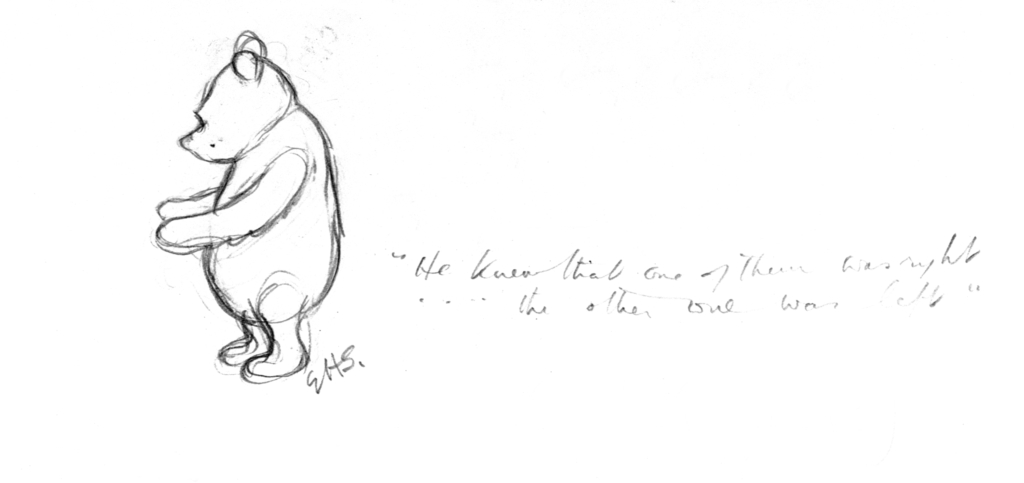
But the reason we are celebrating Winnie-the-Pooh’s centenary this year is because the first collection of Winnie-the-Pooh stories was published on 14 October 1926. Those ten stories introduced not only Pooh, but most of the other characters we now know: Piglet, Rabbit, Eeyore, Kanga, Roo, Owl and, of course, Christopher Robin, based on Milne’s son.
© E. H. Shepard LLP / The Estate of E. H. Shepard
Three: Winnie-the… who?
In the months between the ‘Teddy Bear’ poem and The Wrong Sort of Bees, Christoper Robin’s Edward Bear had become Winnie-the-Pooh. But where did that name come from?
In the early 1920s the Milnes enjoyed going to London Zoo. There, they would regularly visit a Black Bear cub called Winnipeg, or ‘Winnie’ for short. Winnie had been given to the zoo in December 1914 by a British-born Royal Canadian Army Veterinary Corps soldier called Harry Colebourn. He had adopted Winnie as a cub, named the orphaned bear after the city where he was living, then taken Winnie back to the UK.
‘Pooh’, meanwhile, was a name initially assigned to a swan who also appeared in Milne’s 1924 poetry collection When We Were Very Young, as he reveals in a note at the beginning of the book:
Christopher Robin, who feeds this swan in the mornings, has given him the name of ‘Pooh.’ This is a very fine name for a swan, because, if you call him and he doesn’t come (which is a thing swans are good at), then you can pretend that you were just saying ‘Pooh!’ to show how little you wanted him.
When We Were Very Young (1924)
In the first Winnie-the-Pooh collection, Milne confirmed the name had passed from swan to bear:
If you happen to have read another book about Christopher Robin, you may remember that he once had a swan (or the swan had Christopher Robin, I don’t know which) and that he used to call this swan Pooh. That was a long time ago, and when we said good-bye, we took the name with us, as we didn’t think the swan would want it any more.
Winnie-the-Pooh (1926)
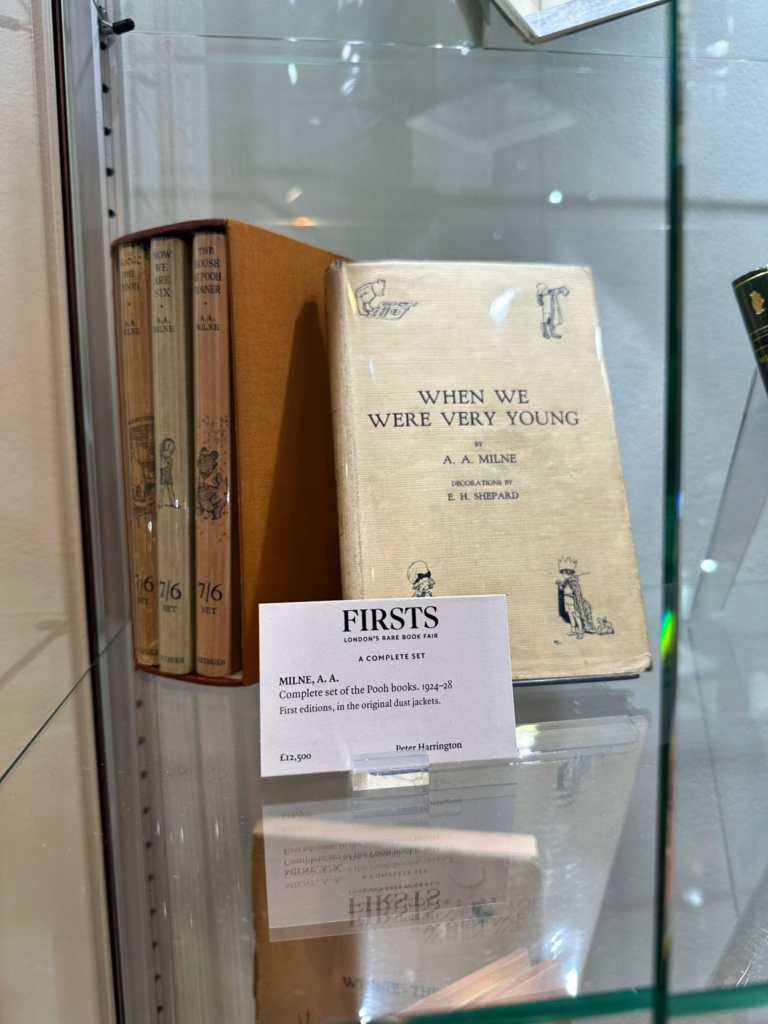
A complete set of the Winnie-the-Pooh books, 1924-1928. © Winnie-the-Pooh at 100: The Exhibition at London Rare Books Fair 2026.
Four: From page to screen
After Winnie-the-Pooh was published in 1926 two more collections followed: a selection of poems called Now We Are Six in 1927 and The House at Pooh Corner in 1928, which also introduced the irrepressible Tigger.
Despite there only being four Winnie-the-Pooh books (including When We Were Very Young) Milne’s stories, along with EH Shepard’s beloved illustrations, were wildly successful. They became a fixture on bookshelves all around the world. So recognisable were the characters and stories that when film producer Stephen Slesinger acquired the merchandising and media rights in 1930, his product ranges helped launch the world of modern licensing.
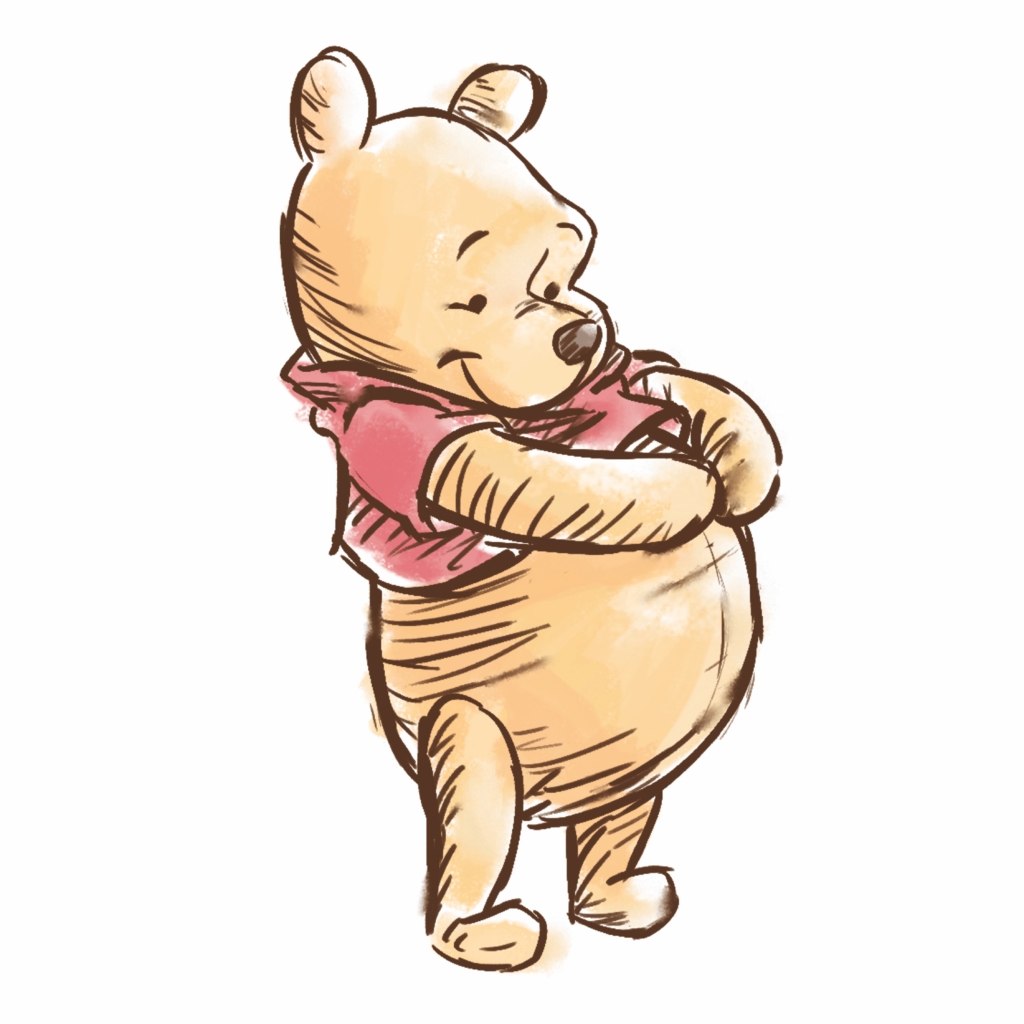
Slesinger’s extensions of the world of Winnie-the-Pooh – toys, games, puzzles, radio broadcasts – helped bring the Hundred Acre Wood to the whole wide world and to the attention of Walt Disney, who became interested when his daughters read the books in the late 1930s. It wasn’t until 1961, however, that Disney finally acquired the media and merchandising rights from Slesinger’s widow, Diane. The first Disney film, Winnie the Pooh and the Honey Tree, was released a few years later, in 1966. There have been dozens of Pooh films in the decades since, most recently the 2018 live action film Christopher Robin.
© Disney
Five: The RLF’s Pooh Papers
For a short series of books written about a “bear of little brain”, the rights situation around the Winnie-the-Pooh became increasingly complicated over the years. When Milne died in 1956 the literary rights to the characters and stories passed to his wife, Daphne (born Dorothy de Sélincourt). When she died in 1971, these rights were split between four beneficiaries: his family – which included his then-adult son, Christopher Robin Milne, and his granddaughter Clare Milne – the RLF, Westminster School and the Garrick Club. Collectively this entity is known as the Pooh Properties Trust, and this is why we have in the basement of the RLF’s offices a box of documents sometimes referred to as the ‘Pooh Papers’.
It may sound unappealing, but this set of mostly legal letters and documents charts the intricacies of a very complex situation. For 30 years Disney maintained the majority of the merchandising and media rights to Winnie-the-Pooh, paying royalties to the Pooh Properties Trust, which still owned the literary rights. With so many people involved, there was inevitably a lot of correspondence. One of those letter writers was Spencer Curtis Brown, from the renowned London literary agency that continues to represent the Milne Estate today. In a 1978 letter to a Disney lawyer, Curtis Brown writes:
Long before the Disney film, these books had been made known to, and loved by hundreds of thousands, and several generations of children through the creative skill of AA Milne.
Spencer Curtis Brown, AA Milne’s agent, in 1978.
After years of back-and-forth, Disney bought out the Pooh Properties Trust’s remaining merchandising royalties in 2001, in a deal that helped secure further funding for the work of the RLF.
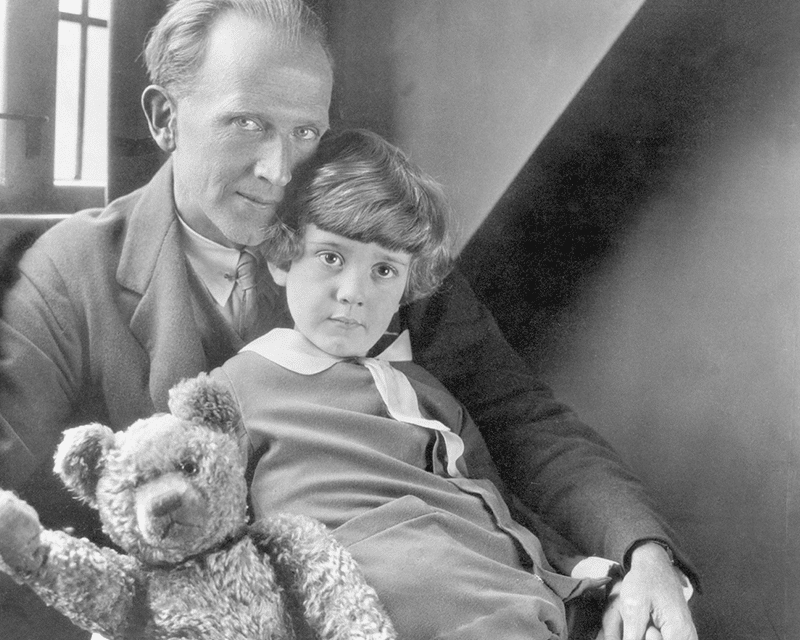
AA Milne; Christopher Robin Milne and Pooh Bear © Howard Coster
Six: A writer helping writers – the legacy of Winnie-the-Pooh
An essayist, humourist, playwright and novelist, Milne was already an established writer before Winnie-the-Pooh made him famous. He also served as a lieutenant in WW1 before being invalided back to England with Trench Fever. In 1934 he wrote an essay, Peace with Honour, about his pacifism, but when WW2 broke out a few years later he joined the Home Guard and wrote a second pamphlet, War with Honour, to outline his position that war was “a lesser evil than Hitlerism.” Whatever the subject Milne understood, always, that words have power.
The RLF began receiving money from the Milne Estate in 1972, following Dorothy Milne’s death the previous year. In the years since, this has generated a staggering £91 million for our grants, education, and outreach programmes.
So, while Milne’s Winnie-the-Pooh stories have continued bringing joy to millions, they have also been helping us further his legacy, supporting writers through some of the toughest moments in their careers.
Which is certainly something worth celebrating.
‘Pooh, promise you won’t forget about me, ever. Not even when I’m a hundred.’
Christopher Robin in The House at Pooh Corner.
This article originally appeared on our Substack. Main illustration © E. H. Shepard LLP / The Estate of E. H. Shepard.
You might also like:
Save the Hundred Acre Wood – the real story behind the new BBC Radio 4 play
A new play, written by RLF Chief Executive Edward Kemp, on how Christopher Robin Milne helped save Winnie-the-Pooh’s fictional home.
Going all in on Dads reading – and being inspired by a “silly old bear”
To mark the National Year of Reading and 100 years of Winnie-the-Pooh, Jim Beckett on the importance of parents reading…
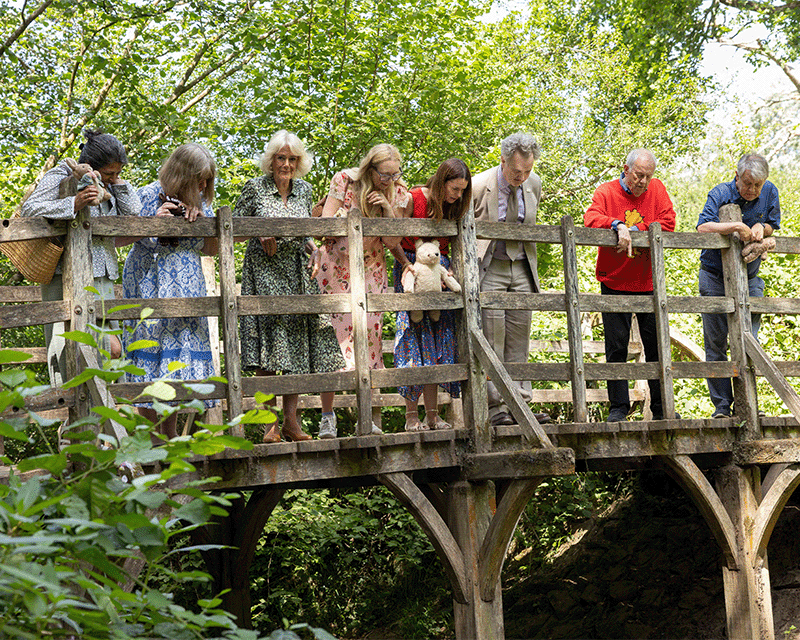
HM The Queen plays ‘Pooh Sticks’ and celebrates the legacy of AA Milne
The RLF hosted our patron, Her Majesty The Queen, at a special 100th anniversary celebration for AA Milne’s Winnie-the-Pooh