
- RLF News
- Article
Writing for Life in the National Year of Reading: reflections from our writers
- 23 September, 2026
Reading Round
This summer, Reading Round – our programme of community-focused reading groups run by Writing for Life writers – launched a range of new courses in libraries, NHS settings, hospices and in 11 prisons across the UK. Partnering with the National Literacy Trust, the new, abbreviated Reading Round groups are part of this year’s National Year of Reading campaign.
The first of our Reading Round short courses in prisons was led by Rhiannon Tise, who worked with a group at HMP Maidstone earlier this year. The course was a great success, with the group reading work by Norman McCaig, Elizabeth Bishop, Avril Joy and Colum McCann.
My aim in the short time I was at HMP Maidstone was to create a positive, encouraging space for the men to share their views on the literature we read, but also to suggest ways they could take what they had experienced into their general reading. I was so glad to read such positive feedback. I could also see how much they’d enjoyed the sessions in their faces – they shook my hand and asked me when I was going to come back. At the end of the first session, one of the men said that he kept feeling like he was back in the classroom aged nine listening to his teacher read to him, and that was a really good thing. He said he didn’t read then because he found it hard but that maybe if he had read then his life would have taken a different path.
Rhiannon Tise, Reading Round Fellow
Writing for Self-Expression
Writing for Self-Expression, another programme of courses facilitated by our Writing for Life writers, uses poetry to encourage participants to explore their experiences, thoughts and feelings through the written word, including working with people in mental health and addiction recovery.
ReCoCo is a Recovery College Collective based in Newcastle-upon-Tyne set up to provide support for and by those with experiences of mental health and addictions. Anna Woodford, who runs Writing for Self-Expression courses through ReCoCco, explains how she uses writing to help foster wellbeing and connection among the groups’ participants:
Writing itself may not be the sole or primary aim. The emphasis is on expressing feelings rather than producing a crafted piece of writing. Some might come to a Writing for Self-Expression session solely to build their confidence, others might want to write for well-being and then there are those who are already committed and experienced writers.
At most reading or writing workshops a level of defensiveness is common, but it is perhaps particularly common among groups in recovery colleges, and it is easy to interpret quietness, or someone saying they don’t know why they have come, in a negative way. Still, I have often been surprised. The person eyeballing me, perhaps, is the one who keeps coming back week after week. The crying woman who wanted the earth to swallow her up asked to be informed of future Writing for Self Expression workshops.
Anna Woodford, Writing for Life Fellow
For the participants who attended Anna’s ReCoCo sessions this year, the sessions were immensely valuable, with many taking the time to share their positive feedback. One participant said: “I thought it was propa mint! It had an excellent and different way of practising creative writing. Thoroughly enjoyed it, Anna is a great facilitator, and I would really like to do it again. Thank you very much – Peace out.”
Facing down imposter syndrome
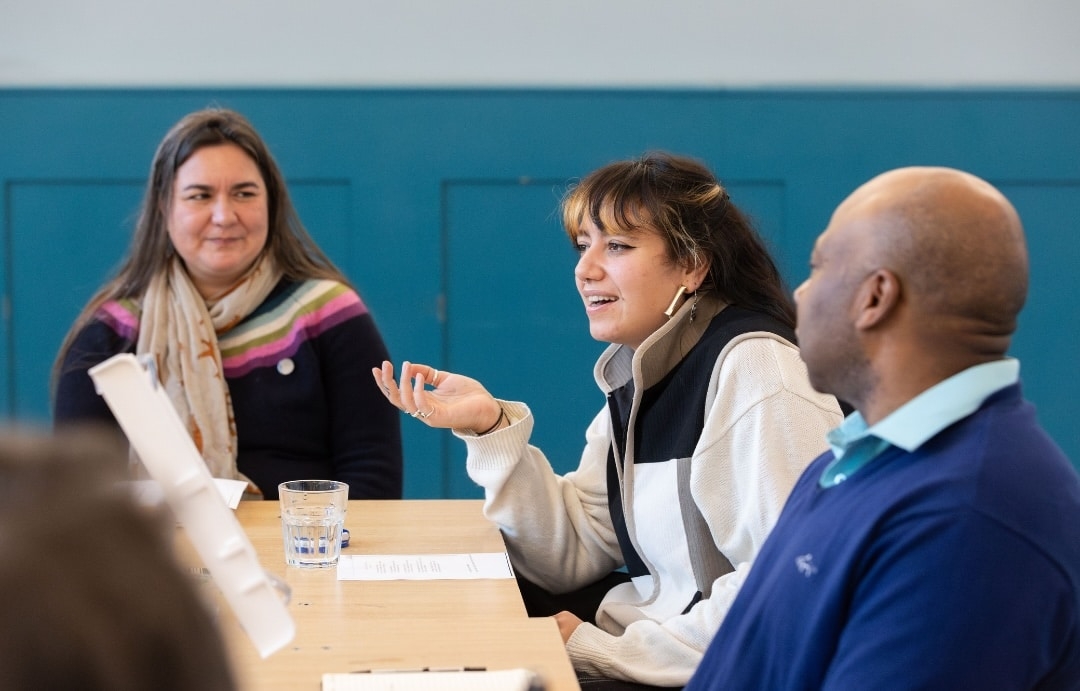
Jini Reddy leading a discussion. © Adam Laycock.
It isn’t just the participants taking in a Writing for Life session who benefit. For the writers, too, running a session is a very rewarding experience, as Writing for Life Fellow Jini Reddy explains:
“When I arrived in Birmingham for my initial Writing for Life induction, I was anxious and simply hoping I’d measure up! Like many writers, I suffer from imposter syndrome, exacerbated by the unease of routinely being one of the few (or only) people of colour in any professional gathering. However, the group was more diverse than I’d anticipated, and everyone was friendly and welcoming, so that helped!
When I learned that many of the workshops are run online, I was horrified. Dear God, not tech. Not screensharing. As a writer, I’ve run workshops, but hitherto only in person. To get up to speed, I obsessively watched ‘how-to’ videos on YouTube and practiced at home and with friends. I even bought a big second monitor! Now, having run one Writing for Self-Expression course and two Writing for Confidence workshops online (plus a third in person), it seems ludicrous to me that I was so fearful of a few digital clicks!
As a (mostly) ex- travel writer who has journeyed alone in the world, often in wild landscapes, I’ve experienced many, many unknowns, and yet I was quaking at the thought of this new gig. I guess I’d come to a place in life where I wanted to stay in my comfort zone. Writing for Life has been a rude awakening in that respect, as I’ve had to adopt a humble ‘beginner’s mind’ in order to master the art of delivering the workshops and engaging with participants in Recovery Colleges. But now that I have done it, I feel a genuine sense of achievement and stronger too – it has been a workout for my psyche.
Of course, I can still feel anxious before my sessions. I am very conscious of the responsibility I carry, of the spiel I need to remember, of the prompts and poems, excerpts or exercises to work through. There are many different, unknown faces staring back at me, or worse, a black screen when people choose to turn their cameras off. (At times, I’ve felt like I’m conducting a séance! )
Then there is the sheer lottery of numbers. I’ll be told eight people have signed up, and three shy, hesitant faces will appear. Or I’ll have a full house, and everyone will be wonderfully engaged and supportive of one another, the chat box humming. The ups and downs are real! More than once, my throat has dried up from nerves, and I’ve had to guzzle honey. (This seems an apt remedy given RLF’s source of funding!)
No matter whether they are shy or chatty, upbeat or glum, the courage and heartfelt, honest sharing of participants has never failed to move me. I’ve seen some writing of a calibre that makes me wonder how many gifted scribes are hiding in plain sight.
I’ve also learned that my innate sensitivity is a gift in this setting. I empathise with those who feel unseen or unheard, whatever the reason. When participants share their thoughts, their pain or their joy, whether through their writing or in conversation, I do my utmost to respond with an open heart. Through active listening, I try to offer others the feeling of connection that can be so hard to come by. I’d never have been able to articulate this so clearly to myself, were it not for Writing for Life, and the other brilliant opportunities the RLF has given me. The learning, the work, the lessening of financial worries that comes with it, the collegiate support – all of it has been a blessing, so thank you.”
Our Writing for Life programmes enable writers to share their skills in the community and workplace. Find out more about our Writing for Life writers here.
You might also like:
Bringing the joy of reading to adults across the UK
The RLF’s Reading Round expands, with groups announced in prisons across the UK in celebration of the National Year of…
70 fascinating facts you might not know about the Royal Literary Fund
To celebrate our 235th birthday on 18th May, we’ve put together a selection of fascinating facts about the RLF from…
“Our shared interest is in the imagination” – Our Reading Round group in Bristol
“The simplicity of it is key,” says Dr Edson Burton, writer, historian, playwright and tutor, who is running a RLF Reading Round group…