
- Collected
- Article
Crown of Blood: adapting the Scottish play into the Yoruba play
- 23 April, 2026
- Dipo Agboluaje
Earlier this year Crown of Blood, playwright and RLF Fellow Oladipo ‘Dipo’ Agboluaje’s Yoruba adaptation of Shakespeare’s Macbeth, opened at The Crucible, Sheffield’s renowned production theatre, before beginning a UK tour.
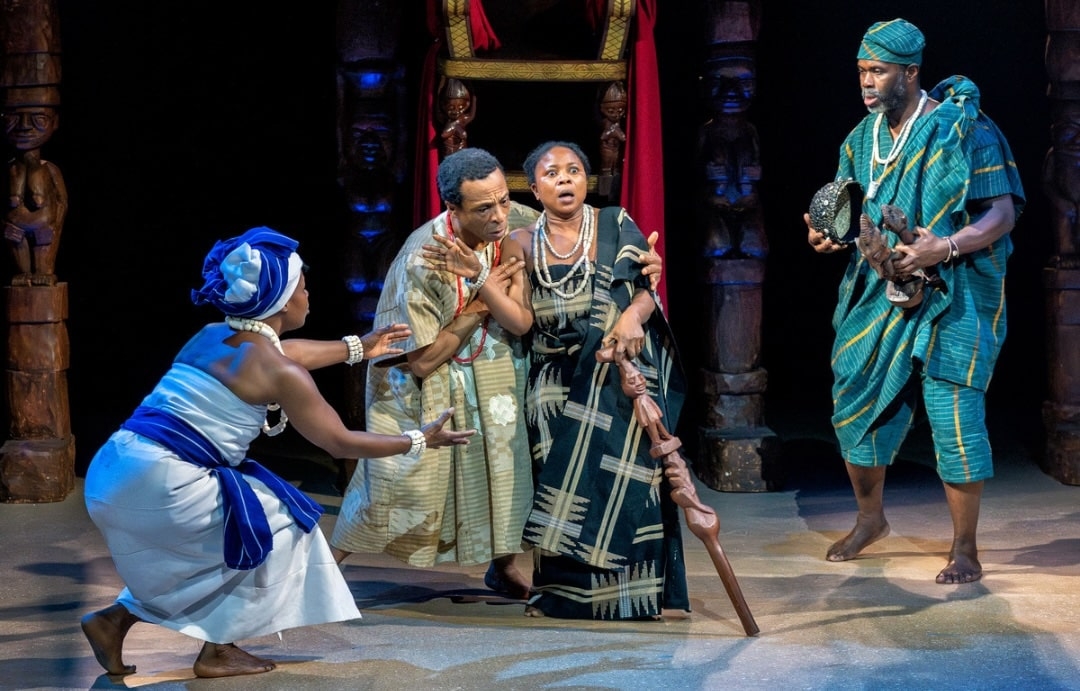
A co-production by Sheffield Theatres and Utopia Theatre, a leading voice in African theatre led by Founder and Artistic Director Mojisola Kareem, Crown of Blood takes the central story of Macbeth and transports it into 19th-century Yorubaland.
As we mark Shakespeare’s birth – and death – day today, 23 April, Dipo tells us about the inspiration for Crown of Blood, and how it extends even further than the oft-told tale of murderous Macbeth and his calculating wife:
 I had previously worked with director Mojisola Kareem on a play based on her relationship with her grandmother, mother and her daughter, titled Here’s What She Said to Me. The play spanned generations and continents and was both epic and intimate. Our collaboration was based on detailed research and workshops, which included all the principal creatives from the conception stage, which is Mojisola’s practice. Mojisola’s company, Utopia Theatre, is the resident company at the Crucible in Sheffield. When she asked me to adapt Macbeth to a Yoruba setting, I said yes without reservation. In a sense I was destined to write a play like Crown of Blood.
I was born in Hackney, East London. Returning to Nigeria in the seventies, the epic dramas on television stoked my interest in Yoruba culture, history, and folklore. Up until then, to my classmates, I was the new boy from London who spoke funny and was always reading stories about Greek and Norse mythology, and devouring American and British comic books like Battle, Tiger and Scorcher, and Whizzer and Chips during lunch break. One particular play, Duro Ladipo’s Oba Koso (The King Did Not Hang), was a dramatic imagining of the story of Sango, King of Oyo, later deified as the Ggod of Tthunder. I still remember that night in Ibadan, where it seemed the whole city gathered around TV sets to watch the adaptation of this legendary stage play. It triggered a feeling in me that I never got from Greek and Norse mythology. For the first time, I understood myself to be part of a cosmological landscape unique to my people and me.
At the University of Benin, where I studied theatre arts, I read epics such as Ola Rotimi’s The Gods Are Not to Blame, Kurunmi and Ovonramwen Nogbaisi; Ebrahim Hussein’s Kinjeketile; and Wole Soyinka’s Death and the King’s Horseman. Pedro Obaseki, a former student who returned to teach at the university, wrote and produced his own historical epic, Obaseki. By this time, I had decided I wanted to be a playwright, and, gathering these influences, the dream was to one day write my own epic.
Before Crown of Blood, I had written an adaptation of The Tempest titled Knock Against My Heart, for Theatre Centre in collaboration with the Rio-based company Nos Do Morro. Directed by Michael Judge, we worked with a cast of Brazilian and British actors to create the story and performance mode that incorporated two dramatic traditions. The Brazilian actors relied as much on the physical as the verbal to tell the story. African cultures, especially Yoruba culture, heavily influence Brazilian culture. Therefore, the adaptation was an engagement between Africa and its European and South American diasporas.
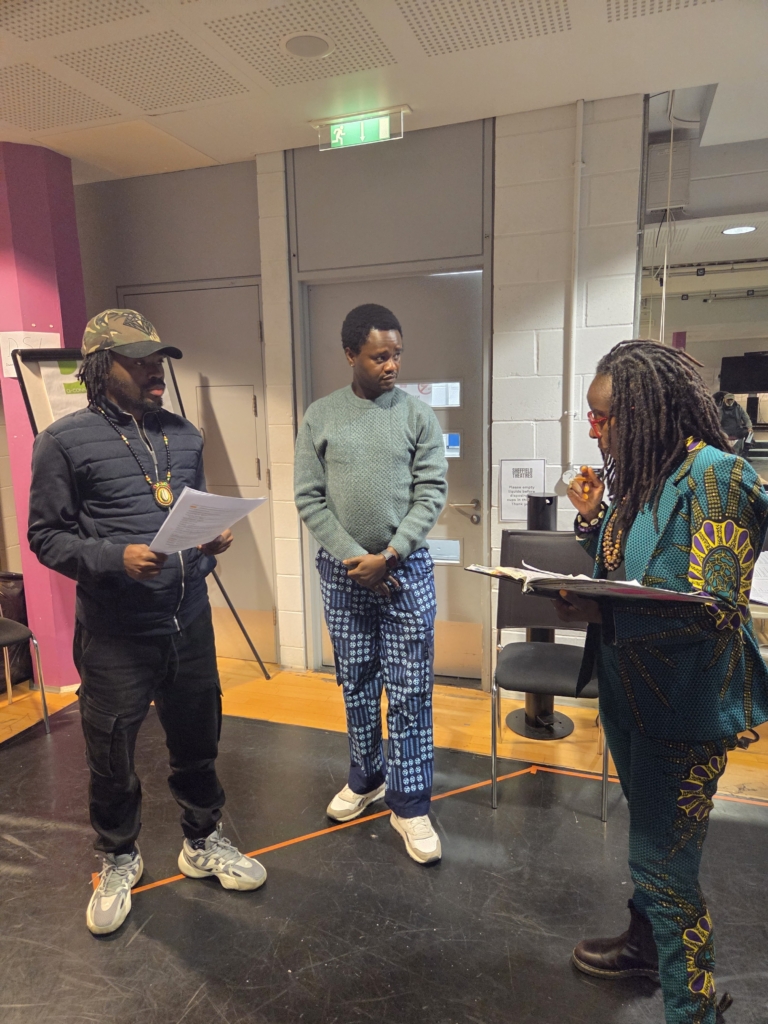
Director Mojisola Kareem (right) works with actors Adeniyi Olusola Morolahun and Omobolanle Akanbi during Crown of Blood rehearsals.
Crown of Blood’s development began with a weeklong workshop at the Crucible. I submitted three scenes for us to work out the style of the play. In the room at this early phase with the actors were the sound designer, the choreographer and the musician. We also had Lekan Balogun, a playwright, dramaturg, and cultural consultant, and Ajide Adeyemi, a babalawo (diviner) who was our consultant on Yoruba spiritual practices. The workshop was designed to ensure everyone was on the same page about the play’s aesthetic: an immersive Yoruba drama that would play to a diverse audience in the UK without diluting its authenticity.
I took the spine of Shakespeare’s play – of a man, along with his wife, conspiring to seize the crown after a prophecy reveals he will be king. The big question for me was how the spine would work in 19th-century Yorubaland, with its unique cultural and political setting. I took a deep dive into Yoruba history, devouring journal essays about the period and seminal texts like Samuel Johnson’s The History of the Yorubas. I identifiedwhat was possible within the world of my story and began to work out a structure and shape the characters. I also watched many Yoruba-language epic dramas.
From these sources emerged the backdrop of the 19th-century Yoruba civil wars, a period of internal conflict within the Oyo empire. Aderemi, a general and war hero, is given a prophecy that he will become king. Unknown to him, the prophecy is false, a scheme cooked up by his wife Oyebisi and her desire to take revenge upon the empire for enslaving her and destroying her home during the empire’s war of expansion. This meant that Oyebisi would be more involved in the action than Lady Macbeth. As a disquisition on the nature of power and ambition within a Yoruba philosophical framework, and given that a major attribute of African drama is that it is a communal event, the other characters are featured prominently. This gave the story a three-dimensional quality, providing audiences with a survey of the society at the time without unnecessary exposition.
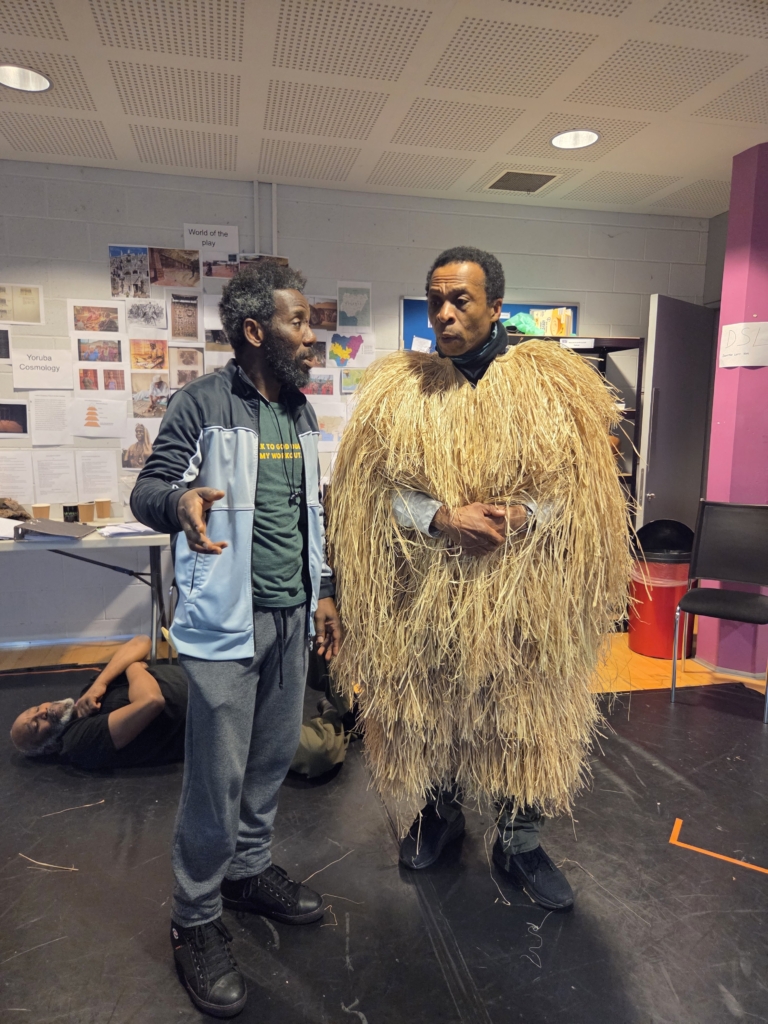
Actors Tunji Falana and Jude Akuwudike during Crown of Blood rehearsals.
Crown of Blood’s development began with a weeklong workshop at the Crucible. I submitted three scenes for us to work out the style of the play. In the room at this early phase with the actors were the sound designer, the choreographer and the musician. We also had Lekan Balogun, a playwright, dramaturg, and cultural consultant, and Ajide Adeyemi, a babalawo (diviner) who was our consultant on Yoruba spiritual practices. The workshop was designed to ensure everyone was on the same page about the play’s aesthetic: an immersive Yoruba drama that would play to a diverse audience in the UK without diluting its authenticity.
I took the spine of Shakespeare’s play – of a man, along with his wife, conspiring to seize the crown after a prophecy reveals he will be king. The big question for me was how the spine would work in 19th-century Yorubaland, with its unique cultural and political setting. I took a deep dive into Yoruba history, devouring journal essays about the period and seminal texts like Samuel Johnson’s The History of the Yorubas. I identifiedwhat was possible within the world of my story and began to work out a structure and shape the characters. I also watched many Yoruba-language epic dramas.
From these sources emerged the backdrop of the 19th-century Yoruba civil wars, a period of internal conflict within the Oyo empire. Aderemi, a general and war hero, is given a prophecy that he will become king. Unknown to him, the prophecy is false, a scheme cooked up by his wife Oyebisi and her desire to take revenge upon the empire for enslaving her and destroying her home during the empire’s war of expansion. This meant that Oyebisi would be more involved in the action than Lady Macbeth. As a disquisition on the nature of power and ambition within a Yoruba philosophical framework, and given that a major attribute of African drama is that it is a communal event, the other characters are featured prominently. This gave the story a three-dimensional quality, providing audiences with a survey of the society at the time without unnecessary exposition.
An important consideration was how to stage the spirit world to reflect the belief system, and how and when the ancestors and deities intervene in human affairs. We had to represent the circular cosmology of the Yoruba of humans, ancestors, deities and the unborn and how the relationship between them drives the action as much as human agency. It was all done through action. The dialogue was purposive and therefore clear in statingthe intentions of the characters. Combined with the set, lighting, costume, music and sound, the stages of the Crucible and later the Belgrade Theatre in Coventry were transformed into a space where such a world could credibly exist.
Adapting Macbeth has been a special endeavour. It has allowed me to fulfil my dream of writing a Yoruba epic. I have engaged with it through other versions, particularly Akira Kurosawa’s Throne of Blood, whose title mine echoes, and Orson Welles’s expressionistic version. Most of all, it has solidified my attitude towards adaptations, that the original must bend to the concerns and aesthetics of a new setting, and that the adaptor must see it as one text in conversation with many others, to make us see it in a new light.
This article originally appeared on our Substack.
Cover image shows Kehinde Bankole as Oyebisi and Deyemi Okanlawon as Aderemi in Crown of Blood, Utopia Theatre & Sheffield Theatres. © Robling Photography.
You might also like:

Doing it for the Kids: Children’s authors and the trouble with altruism
Karen McCombie on the challenges of writing for children, when the art of reading is itself facing challenges.
“Nothing about us without us” – Jonny Wright on Black television
RLF Fellow and screenwriter Jonny Wright on the evolution and impact of Black television, from 1990s American shows The Cosby…
From first draft to final edits: Abigail Avis on writing Wet Ink
In the first of a four-part series on the publication of her book, Wet Ink, Abigail Avis takes us back…