
- Collected
- Article
From the archive to the stage: Julia Pascal on the complexities of dramatising real historical figures
- 29 October, 2026
- Julia Pascal
I am often asked where I get the ideas for my plays. The Banality of Evil: Hannah Arendt, France 1940, my latest play, was provoked by a conversation with my American cousin David Daube. We were walking on a French beach, on a family holiday in 2017, when he mentioned his aunt Eva’s teenage history. She was the daughter of German Jews. Her father had been murdered by the Nazis as part of their Euthanasia Programme. After this catastrophe, she and her mother left Mannheim and were arrested as enemy aliens in France. This was all in 1940, before the country surrendered to the Germans.
Eva Daube was 16 when she was transported to a wasteland near the Spanish border and imprisoned in the internment camp Gurs. I discovered that Hannah Arendt, the philosopher and political theorist, had also been in the same prison as had the artist, Charlotte Salomon. What would happen if the three met there? I wondered. It was this question that started me on the idea of writing this drama.
My protagonists fell into three powerful archetypes. Hannah (33) was The (Intellectual) Leader, Charlotte (22) was The (Poet) Artist and Eva (16) was The (Dreamer) Idealist. Their experiences between May and July 1940 drove the play’s urgent narrative structure of arrest, incarceration and escape. A moment of utter chaos in the camp when the Germans arrived in the summer of 1940, offered a window of escape for those willing to risk it. According to records, Hannah Arendt, Eva Daube and Charlotte Salomon were among those who fled. With the aid of US sponsors, Arendt and Daube secured exit papers. Salomon, who had no American friends or family, was later arrested by the Nazis in Vichy France. At five months pregnant, she was deported to Auschwitz, where, at the age of 26, she was gassed.
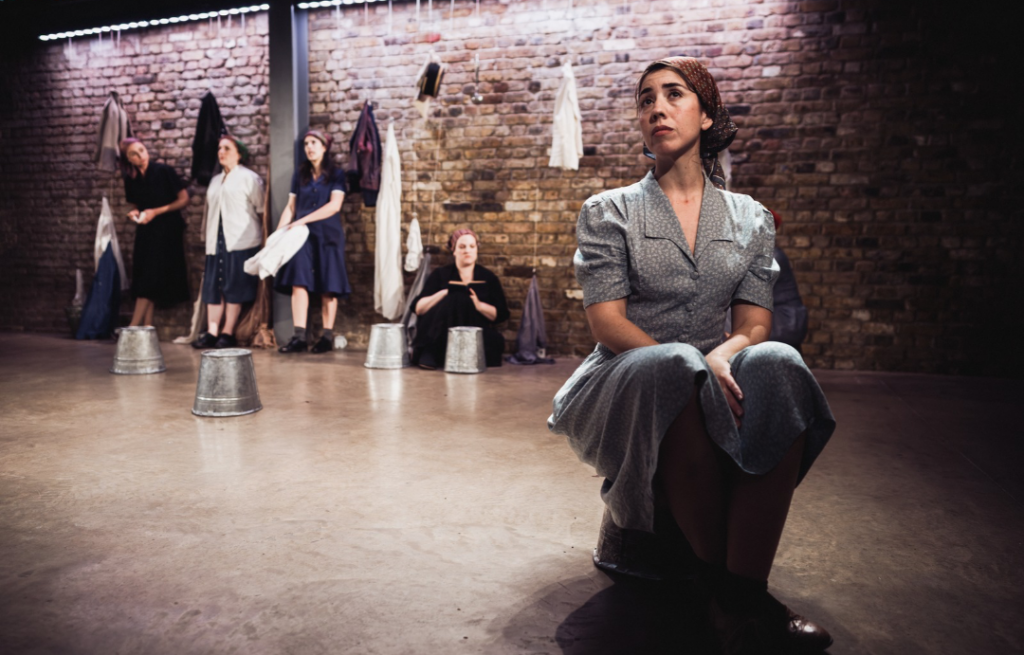
(lr) Mai Weisz, Helen Goldwyn, Ariella Barnett, Anja Fahlenkamp with Anna Eckhard (foreground) as Charlotte Salomon in The Banality of Evil: Hannah Arendt, France 1940, at The Arcola Theatre, October 2026. © Alex Brenner.
I was motivated to reveal this ‘reluctant’ French history for the stage. For this, I needed hard evidence, which I found scattered across various libraries and books, in French, German and Spanish. The official documents are in the departmental archives in Pau. There, I held the flimsy paperwork which endorsed all I had heard. I read about prisoners’ arrivals, evasions and deaths. I could feel how the camp was run. Touching the original paperwork gave me a visceral connection to my cousin’s aunt. I saw Eva Daube’s name on letters. David told me that Eva had been a secretary to the French commander. She may have been sexually involved with him as part of her ‘job’ as translator from German to French. I hint at this knowledge in my play. From other sources I learned how the French gendarmes often raped the women prisoners.
To create all the characters, I had the problem of writing dialogue in English for women who would have been speaking German. Before his death, I had videoed Eva’s brother, Albert Daube. His accent, even after six decades in the USA, was still inflected with German. This helped me write dialogue that was in English but reflected the hinterland of a first-language German-speaker. It also helped that my own grandparents were German and Yiddish-speakers. This means that I am at ease realising the voices of European Jews who left their homes for English-speaking countries at the start of the 20th century.
More particularly, to understand Arendt’s voice and her inner language, I watched her 1964 interview with Günter Gaus. This immediately removed my terror of dramatising such a brilliant mind. Onscreen she was warm, arrogant, ironic and flirtatious. I analysed her body language as much as her voice. Researching her work, and what was written about her, also contributed to my creation of her as a dramatic character. Ronnie A Grinberg’s book Write Like A Man (Princeton, 2024) gave me the sense of her as an assured intellectual and freethinker. I read her writings but most useful for understanding her ideas about being an immigrant was her 1943 essay, We Refugees. This is packed with humour and intelligence and fuelled by her experience of losing country, identity and status. I used some of her direct speech in monologues, as well as adding imagined dialogue for her when she was in Gurs.
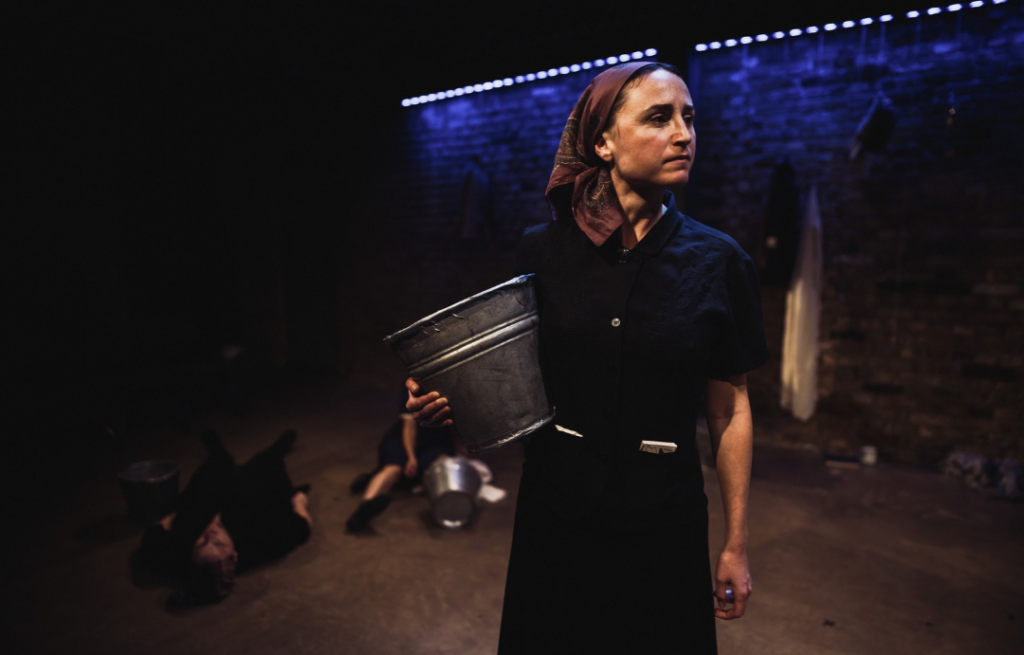
Mai Weisz as Hannah in The Banality of Evil: Hannah Arendt, France 1940, October 2026. © Alex Brenner.
To ‘find’ the character of Charlotte Salomon, I needed to study her art so I went to see her paintings in an exhibition at the Jewish Museum in London. They are also accessible in Amsterdam and online. Her paintings have a triple layer. They are art, text and music – in fact, today her works are seen by many as forming the first graphic novel. So I knew that her character must embody these three interconnected elements. Griselda Pollock’s study Charlotte Salomon and the Theatre of Memory became valuable research for the character construction of Charlotte.
As for Eva, I interviewed David and his cousin, Eva’s son, to understand who she was. They knew her as a vain, older woman. They told me that her life in the US was motivated mainly by the desire to make enough money to enjoy frequent trips back to her beloved Germany. Despite Germany’s hatred of Jews, she still loved the country and could not bear the separation. Her family’s memories, and the way they imitated her voice and expressions, gave me a clear feeling for her personality and attitudes. I also took liberties with the truth. I have written Eva written as a Communist, but in reality it was her murdered half-sister, Trude, who was known to have Communist beliefs. I grafted Trude’s politics on to the character of Eva because I needed a variety of political views to provide argument and tension.
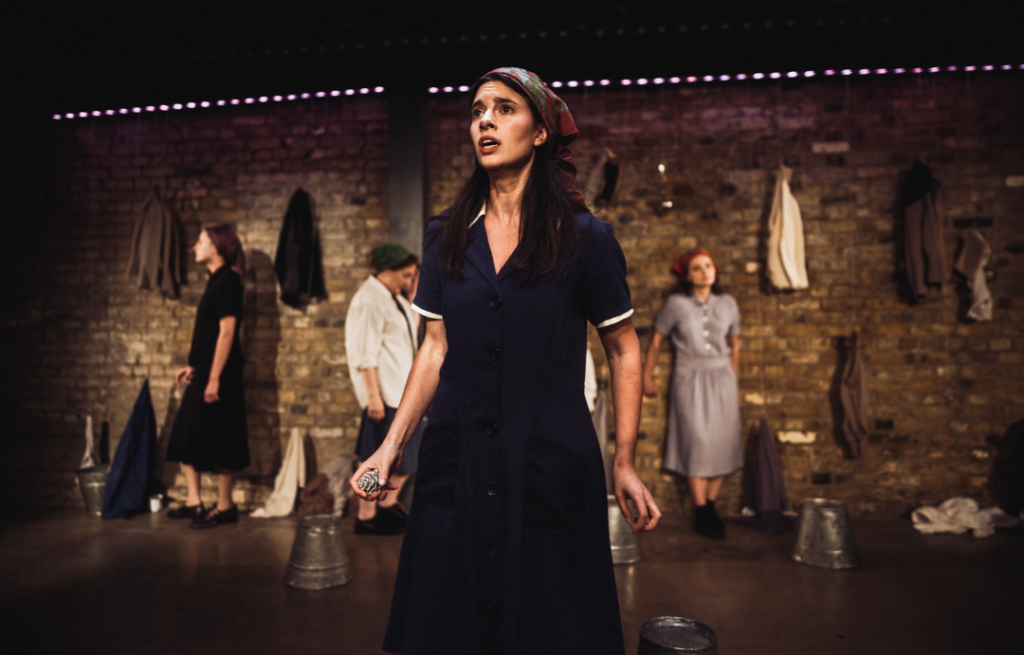
Ariella Barnett (foregrounded) as Eva, with (l-r) Mai Weisz, Helen Goldwyn and Pat Dynowska in The Banality of Evil: Hannah Arendt, France 1940, October 2026. © Alex Brenner.
It was also important to me as a writer to provide a framework which connects each character’s inner and outer worlds. I researched other major events that happened in 1940. This meant finding texts from contemporary newspapers, radio bulletins and adverts. My questions to myself were, what did my characters read, hear and see?
The script underwent development with a dramaturg, academics, workshops and a staged reading.
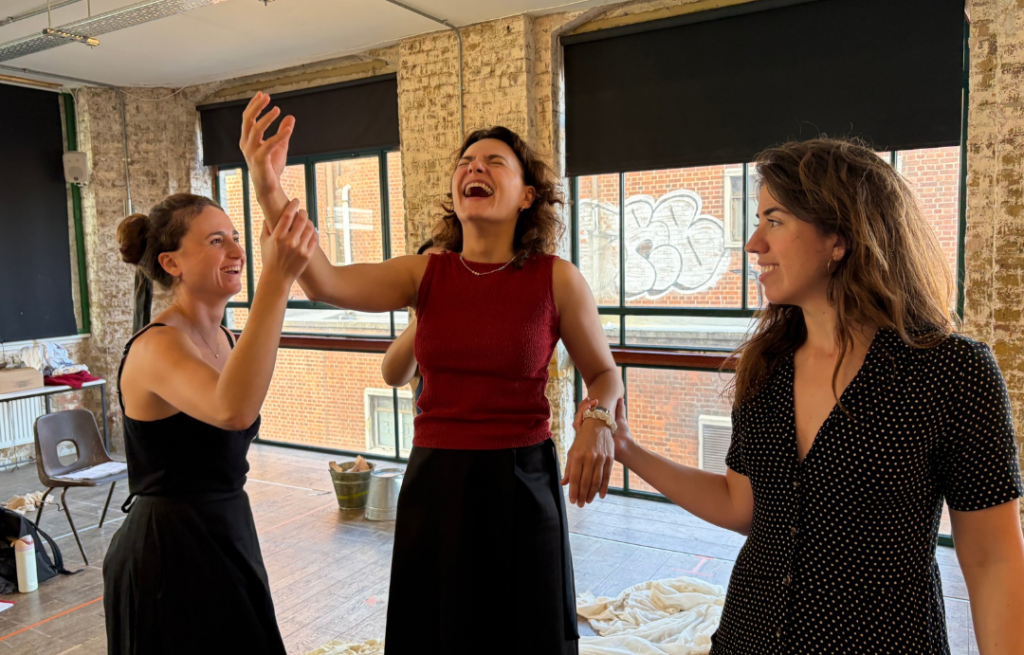
(l-r) Mai Weisz, Pat Dynowska and Anna Eckhard in rehearsal. © Natalie Borenstein
Today, with the play now open at The Arcola, it has been nine years since that initial walk on the beach in France. Since then, it has become even more important to me to write about the hidden stories around the persecution of minorities and women.
Julia Pascal is a writer and director. Her dramas have been seen in the UK, US, Poland, Austria, France and Germany and at the Edinburgh and the Dublin Gay Festivals. They are often rooted in war and use European, minimalist stage techniques to explore complex political histories.
Julia has been produced at the National Theatre, Riverside Studios, the Finborough Theatre, the Tricycle Theatre and the Park Theatre as well as the Staatstheater, Karlsruhe, Germany.
Methuen Drama/Oberon Books publish her scripts. These include The Shylock Play, Woman on the Bridge, Crossing Jerusalem, Blueprint Medea, 12:37, The Dybbuk, St Joan, Theresa and Nineveh. This year she is co-writing The Hysterical Bicycle – An Indian American Tragedy with Anita Chari.
This article originally appeared on our Substack.
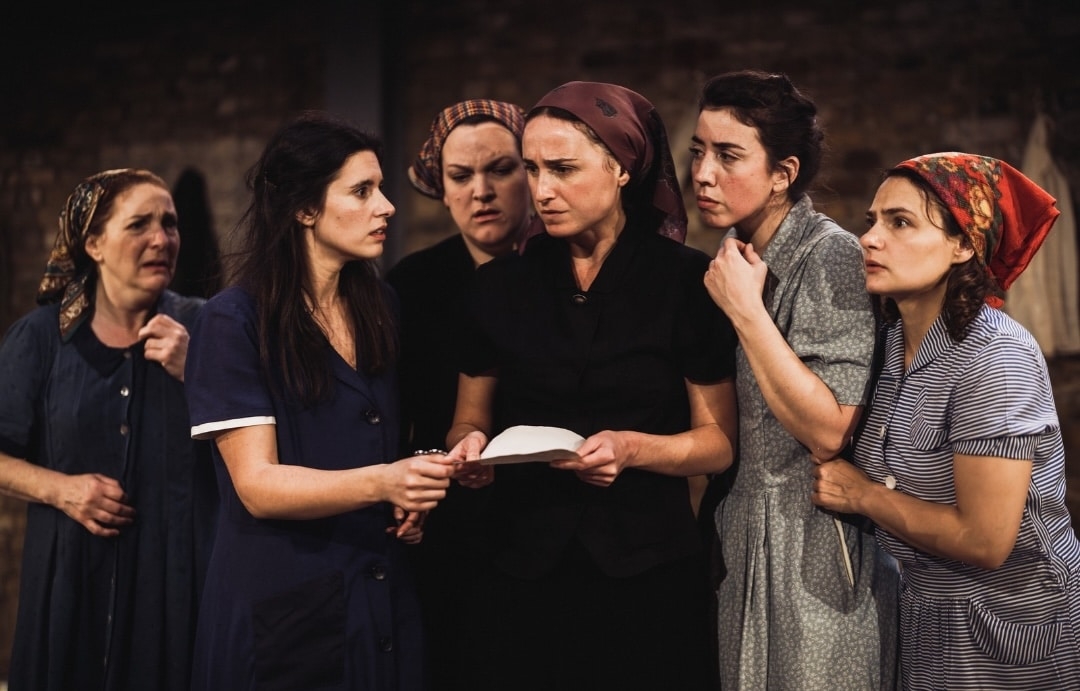
Main image shows Helen Goldwyn, Ariella Barnett, Anja Fahlenkamp, Mai Weisz, Anna Eckhard and Pat Dynowska in The Banality of Evil: Hannah Arendt, France 1940, October 2026. © Alex Brenner.
You might also like:
Stephen Unwin on Man to Man and the art of Anthony Vivis’ translation
As Manfred Karge’s Man to Man returns to The Royal Court, director Stephen Unwin reflects on RLF benefactor Anthony Vivis’…
Crown of Blood: adapting the Scottish play into the Yoruba play
As we mark Shakespeare’s birthday, Oladipo ‘Dipo’ Agboluaje takes us behind the scenes of his Yoruba epic, based on Shakespeare’s…
Making the work invisible: Trish Cooke on Alterations
RLF Fellow Trish Cooke on adapting Michael Abbensetts’ 1978 Windrush era play Alterations for the National Theatre.