
- Collected
- Article
Stephen Unwin on Man to Man and the art of Anthony Vivis’ translation
- 7 September, 2026
The Royal Court Theatre’s production of Manfred Karge’s one-woman show Man to Man – which opened last week, ahead of an October transfer to Edinburgh’s Traverse Theatre, a run at the Berliner Ensemble and in New York City in Spring 2027 – sees Tilda Swinton make a long-awaited return to the stage as part of The Royal Court’s 70th season.
Originally performed at the Traverse before debuting at the Royal Court in 1988, the UK premiere of Man to Man was directed by Stephen Unwin. The English translation of Karge’s seminal play was provided by Anthony Vivis, a former RLF Fellow and beneficiary who also left a portion of his Estate to the charity upon his death.
In between rehearsals, and ahead of Opening Night at the Royal Court, Stephen Unwin took some time to reflect on the original UK production of Man to Man, what it is like to return to the show 40 years on and Anthony Vivis’ work as a translator.
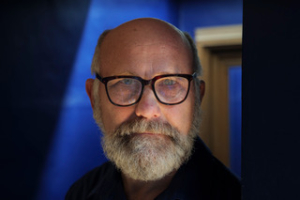
Stephen Unwin
It was in 1986, when I was in my twenties, that I first became aware of the East German theatre director Manfred Karge’s astonishing one-woman play Jacke Wie Hose (1982). Jenny Killick, who was running the Traverse Theatre in Edinburgh at the time, commissioned an English language version from translator Anthony Vivis, and the decision was soon made to stage it.
An immediate challenge was Karge’s title, which is pretty much untranslatable: ‘Jacke wie Hose’ — literally ‘jackets like trousers’ — is the equivalent to ‘six of one, half a dozen of another’. After a lengthy discussion we opted for Man to Man, partly in homage to Robbie Burns and Bertolt Brecht, but also suggesting the deconstruction of masculinity that is so fundamental to the play’s meaning.
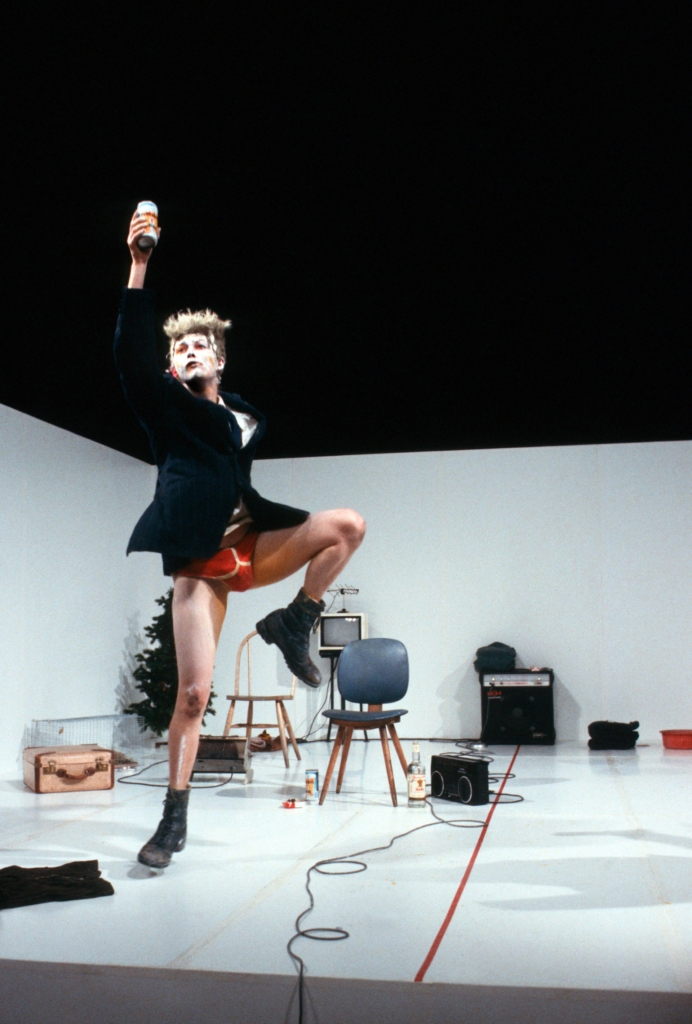
Tilda Swinton in the 1988 production. © Donald Cooper.
My production with the young Tilda Swinton was a succès d’éstime when it was first performed at the Traverse Theatre during the 1987 Edinburgh Festival, and again when it transferred to a sold-out run at the Royal Court Theatre in London the following January. And when David Byrne invited us to revisit Man to Man at the Royal Court this year, Tilda and I insisted that we again use Anthony’s translation, which had provided us with such a solid basis for our work all those years ago.
Man to Man is an extraordinarily dense text and very hard to translate. Karge brilliantly mixes blank verse with rhyming couplets, along with passages of plain prose, quotations from the German classics – especially from Karge’s fellow Brandenburger, Heinrich von Kleist – as well as scraps of popular culture, songs, proverbs, even advertising jingles and doggerel. The playwright offers no stage directions, no explanation of his intentions and minimal punctuation. The result is a deliberate Verfremdungseffekt (Brecht’s famous ‘alienation’ effect) demanding that everyone involved — translator director, designer, actress — is compelled to engage with the words and make creative decisions for themselves.
Anthony’s translation is astonishingly accomplished. Look, for example, at this marvellous passage from a passage describing the character’s contribution to the German ‘economic miracle’:
For three whole years I nail together vegetable-crates
At Paule Packaging. One hundred crates a day.
But then, when Paule goes bust, a man from Hanover
Buys up the lot and starts demolishing
The workshop and the storeroom:
You won’t get on unless you can be drastic.
This Karl-Friedrich Kaste undertakes to take me on.
I start producing plastic and elastic.
I pull a little handle at the front, and out
From the back a thousand plastic punnets pop.
You’ll be stuck here for ever and a day, I tell myself.
Here stand you, and you can do no other.
In front of you, the handle, and behind, the punnets.
Do I turn the handle, or does it turn me.
Am I the handle, is the handle me.
The wordplay, the internal rhymes, the passing reference to Protestant revolutionary Martin Luther’s “Hier stehe ich und kann nicht anders” (“Here I stand, I can do no other”), and the metrically charged verse make it a joy to perform and listen to in the theatre.
At other times, Karge (as translated by Vivis) deploys flinty prose, in a register reminiscent of Georg Büchner, or Karge’s great exemplar, Brecht himself:
When the doctor had finished, he took Dad to one side and told him he’d leave a prescription and call back in a day or two to see if anything could be done. But it was too late, and in no time at all Mum had died of galloping consumption. It was a hard winter, and outside the ground was frozen. Dad fell over and sprained his right hand. And so, as a kid of seven, I was lumbered with all the housework. But first, I had to wash my Mum’s body and put the lace nightcap on her head. Everybody who came to the house sang my praises and told me what a good girl I was, and nobody knew how terrified I was by the fact of death.
This has a raw simplicity which, acted well, catches you by the throat.

Tilda Swinton in Man to Man 2026 – credit Sølve Sundsbø.
Revisiting Man to Man in 2026, I have made some minor revisions to Anthony’s brilliant version. For example, Anthony was more conscientious about British audiences than, perhaps, he needed to be. Thus, he glossed “Arbeit Macht Frei” with “as Hitler said”, and there were other moments when I felt the text could speak for itself. And in some passages, a slightly more colloquial tone seemed better.
As the title demonstrates, proverbs are famously difficult to translate. In a lively meeting in Berlin with Karge and his agent, I discovered two moments when the proverbial nature of the language had been missed. For example, we’d all assumed that the phrase “Jetz war Polen offen” meant that “Poland was open wide” (and that the Red Army was storming through Poland). But, no, as Karge explained to me: “Polen offen” is a colloquial phrase meaning that “all hell is breaking out”.
The biggest challenge was that since Anthony’s death Karge has written two new short scenes: one about the fall of the Berlin Wall in 1989 and the second, requested by Tilda and me, concerned with the chilling reemergence of the German far right. I translated these confidently, but working from within Anthony’s linguistic template.
Anthony was one of our most distinguished translators of German drama. He managed to combine scrupulous attention to the original text, with a brilliant ear for the spoken word. In today’s world of Artificial Intelligence, scrupulous, sensitive translators like Anthony are needed more than ever. I just wish he’d lived long enough to tackle a Brecht play, now that he has come out of copyright.
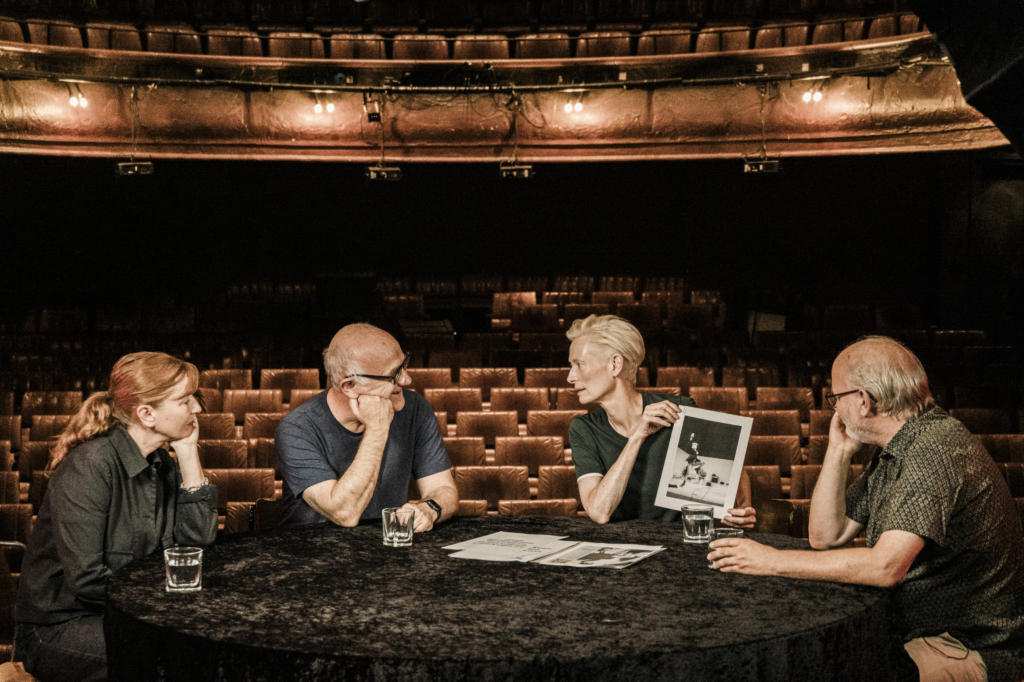
(l-r) Man to Man Stage Designer Bunny Christie, Director Stephen Unwin, Actress Tilda Swinton and Lighting Designer Ben Ormerod look back at photos from the original 1988 production at the Royal Court. © Reudiger Glatz.
Staging Man to Man almost forty years after we first did it is a great joy and an extraordinary privilege. Joining Tilda and me are original stage designer Bunny Christie and lighting designer Ben Ormerod, all now in our sixties. We find ourselves looking back and trying to remember the work of our youth, whilst also exploring those aspects of the text we missed or misunderstood and bringing to bear new skills, new technology and creative new partners. This isn’t a revival, it’s a fresh attempt to stage a play that keeps offering fresh insights – not just into the past, but the present.
And as we prepare to stage Man to Man at the Royal Court once more – followed by a return to the Traverse, a week at the Berliner Ensemble and a season in New York – Tilda and I are forever grateful for Anthony’s brilliant work. Indeed, we have included Anthony, who died in 2013 aged 70, among the group of eight remarkable people to whose memory this production is gratefully dedicated.
Stephen Unwin (born 1959) is an experienced theatre and opera director, responsible for almost 100 productions. He founded English Touring Theatre in 1993 and opened the Rose Theatre, Kingston in 2008. His work has been seen across Britain and in many leading theatre and opera houses. He has written ten books on theatre and drama, as well as Beautiful Lives (2025), a study of the history and culture surrounding learning disabilities. He has also written six original plays and numerous translations. Stephen is an Honorary Fellow of Downing College, Cambridge.
Anthony Vivis was a playwright and translator. Between 1967 and 1971, he was a Dramaturg for the Royal Shakespeare Company in London, reading, translating, seeing, and reporting on contemporary German and French plays. His translations included several of Manfred Karge’s plays and were produced by the National Theatre, RSC, the Royal Court, Bush, Soho Poly and others. From 2001-2002 he was RLF Fellow at the University of East Anglia. He was also an RLF beneficiary, and upon his death in 2013 he donated a portion of his Estate to the RLF.
You can find out more about the RLF’s Estates, including how to make a donation or bequest, here.
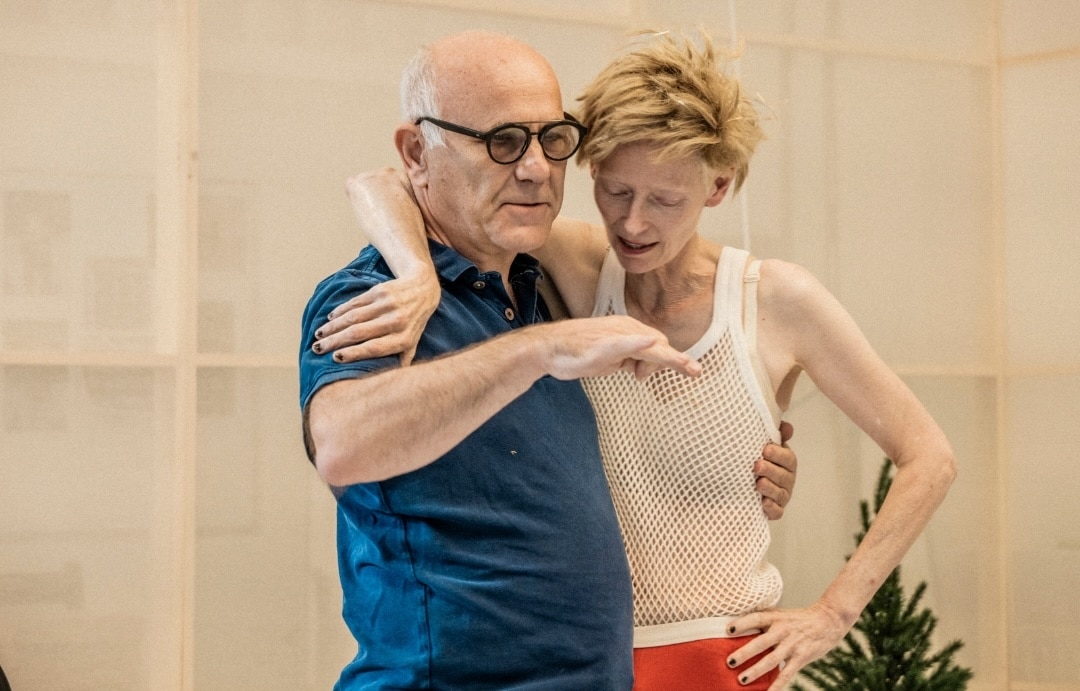
Main image shows director Stephen Unwin in rehearsal with Tilda Swinton. © Reudiger Glatz.
This article originally appeared on our Substack.
You might also like:
Blythe Spirit: Ian Collins on Ronald Blythe
Writer Ian Collins, literary executor of RLF benefactor Ronald Blythe’s estate, on the life and times of the renowned nature…
Our RLF Estates Directory launches online
As the RLF celebrates our 235th anniversary, we’re pleased to introduce our new Literary Estates directory.
From Russia’s ‘Red Ransome’ to The Last Englishman
“I learned so much; I’m grateful to him.” Roland Chambers on his Arthur Ransome years, which he spent exploring Ransome’s…