
- Collected
- Article
From Russia’s ‘Red Ransome’ to The Last Englishman
- 18 January, 2026
- Roland Chambers
Writer Arthur Ransome – who was born on this day in 1884 and donated a portion of his Estate to the RLF upon his death in 1967 – was a journalist and biographer, but is probably best-known as the author of the Swallows and Amazons children’s books. In the 12 individual stories that make up the series, the Walker children and their equally imaginative friends set sail on all manner of nature-inspired adventures, exploring the great lakes and dramatic vistas of the Lake District and other iconic English landscapes like the Norfolk Broads.
But Ransome’s extraordinary life was once defined by other landscapes: those of revolutionary Russia, both before and during the Civil War of 1917 – 1922.
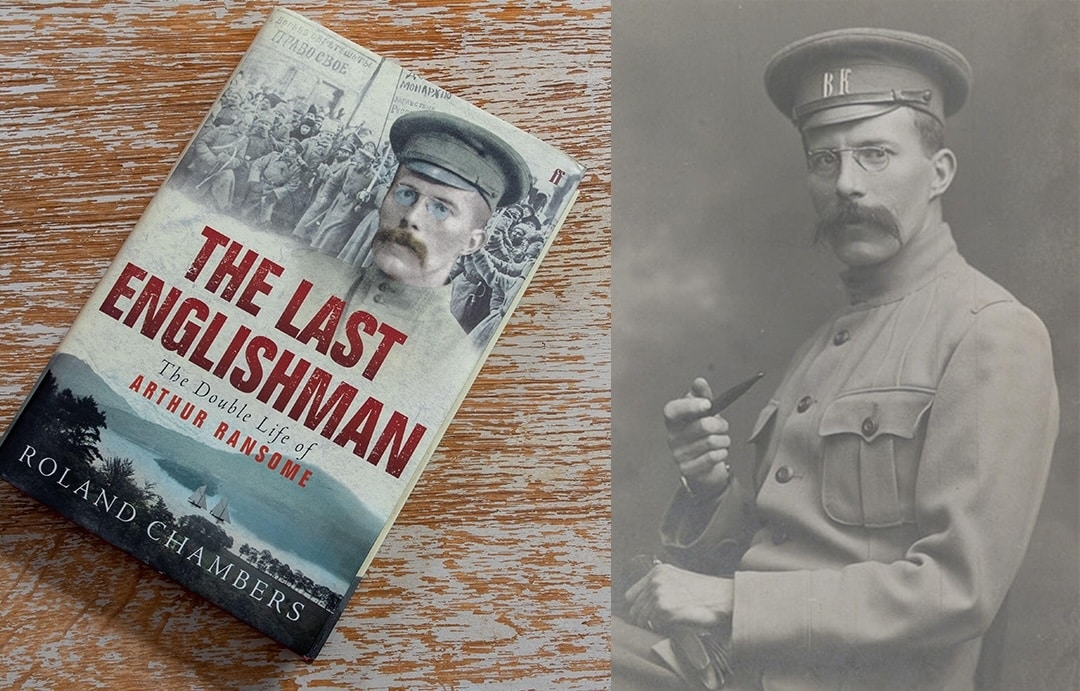
Like Ransome, RLF Fellow Roland Chambers – also a writer, and illustrator, of children’s books – has previously written in other genres, most notably his biography, The Last Englishman: The Double Life of Arthur Ransome. Released in 2009, the book took six years of painstaking research and is, to date, the only literary biography Chambers has ever written. Here, Chambers looks back at his own Ransome years, and turns the spotlight back on Ransome’s time in Russia in the midst of revolution and war.
 Most writers remember the first book they fell in love with. For me it was The Magician’s Nephew by CS Lewis, prequel to The Lion, the Witch and the Wardrobe, and years later, I still live in the world it created, even if the original explosion has cooled. Others may live in different worlds, but the pattern is the same. No book, however great, will ever take the place of that first beloved book: the literary equivalent of the Big Bang.
I got a chance to test my theory properly when I wrote my first (and only) literary biography. The writer I chose was Arthur Ransome, author of the Swallows and Amazons series, not because I loved his books, but because the life he had led before he wrote them was so extraordinary. When Ransome’s readers knew what I knew, it seemed to me, they would never think of him or his stories in the same way again.
Ransome’s life really was extraordinary. Between 1913 and 1924, he worked as a correspondent in Russia and the Baltic, first as a political moderate, then, increasingly, as an apologist for the Bolshevik Revolution. The author of Pigeon Post was the first Western journalist to interview Leon Trotsky, became a bosom friend of the Bolshevik chief of propaganda, and fell in love with Trotsky’s private secretary –, the formidable Evgenia Petrovna Shelepina, whom the American delegation referred to as ‘The Big Girl’. No other representative of a British newspaper was as close to the Bolshevik elite, and it was for this reason that in 1918, Ransome was recruited to the newly created Secret Intelligence Service. He spied for the British on the Soviets while cheerfully sharing sensitive information with Lenin (whom he interviewed twice) and ‘Iron Felix’ Dzerzhinsky, the Bolshevik head of secret police. At one point the British Home Office considered confiscating his passport and prosecuting him under the Defence of the Realm Act.
Ransome’s private life was as complicated as his politics. In 1913, he ran away from a failing marriage and spent the next ten years shuttling backwards and forwards between Russia, the Baltics, Scandinavia and England, where he found it increasingly difficult to explain his life abroad to his wife, his only child, and to friends and family. In 1917, he shared a confiscated palace in Moscow with Evgenia and her sister, Iroida, then, taking advantage of his contacts on every side, brought Evgenia out of Russia at the height of the civil war. After securing a divorce from his first wife, he brought his second back to England in 1924, where he quietly disassociated himself from the Bolshevik leadership, joined the Royal Cruising Club and settled down in the Lake District.
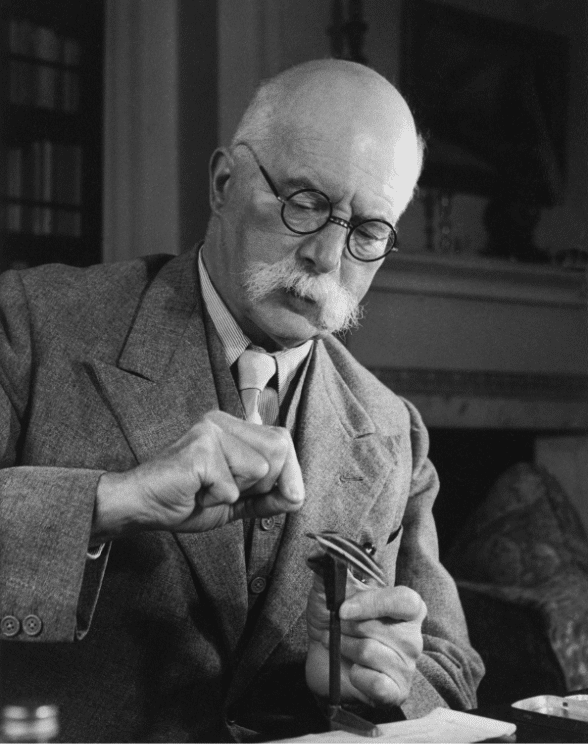
Arthur Ransome by John Gay. © National Portrait Gallery
Ransome had witnessed the most catastrophic global upheaval in history — an explosion so savage that it tore the old world to pieces. In the immediate aftermath of the war, there were corresponding revolutions in mathematics, science and the arts. TS Eliot published The Waste Land; James Joyce produced Ulysses. Ransome was invited to speak at the 1917 Club, founded by Leonard Woolf to promote socialism in England, and he had earned the platform. In America, where he was known as ‘Red Ransome’, his articles were still published with a health warning attached. As a journalist, he had done his best to explain the Russian Revolution sympathetically to the West, but he did not choose to carry the chaos forward. Instead, he joined a group of children’s writers, including AA Milne, to invent worlds that excluded the war and revolution altogether.
Swallows and Amazons was published in 1930 and was an instant hit, followed by eleven further books that cemented Ransome’s reputation as a model Englishman. In 1953 he was made a Commander of the British Empire by the Queen, who as a child had experienced with millions of others a gentle Big Bang: the launching of a boat onto the smooth surface of a lake; the adventures of a crew of decent English children, pitching tents, fighting pirates; a paradise unruffled by bombs or machine-gun fire or the depth charge of violent popular revolution. By the time I came to write The Last Englishman, very few people remembered Ransome for anything but his children’s books, and that was the reason I had chosen him in the first place. I would drop a bomb into his lake and identify in the debris the psychology not only of the writer, but of his readers, too — the children of the war generation, the children who fought the next war. I saw my project as a sort of Large Hadron Collider in which Captain John and his friends would be fired from one end, while Ransome’s real life would be fired from the other, and in the resulting inferno would be revealed the birth of the Modern Age.
And did I succeed? No, I don’t think so. Not really. The Last Englishman caused a stir in broadsheet newspapers and literary magazines. I appeared on the radio, on Newsnight, and toured the usual festivals and book clubs. I got the chance to ask the Ransome Society if they knew that Evgenia had left Russia with her knickers stuffed with diamonds for the Comintern or that her sister, who remained behind, had become deputy director of the Moscow forced labour camp. But the shock was soon forgotten. Today people ask me occasionally if I know that Ransome married Trotsky’s secretary, and I say, “Yes, I wrote a book about it. It took me six years.” Otherwise, his reputation is much the same.
I don’t take offence, and why would I? I can see now that the whole project, while interesting, was based on a category error. Historical catastrophes rip through one generation only to be forgotten by another, which is why history must be written over and over again. Literary Big Bangs, on the other hand, occur whenever the right book is opened, starting with that First Book, which is why I got back to writing and illustrating children’s books. I don’t regret the Ransome years. I learned so much; I’m grateful to him. But for me, the pleasure of writing is closer to the pleasure I have always taken in reading, starting with a lion who sang the living world out of the dead ground. Plenty of people scorn CS Lewis’s books as trite Christian metaphor, but to me they were the real thing, just as Ransome gave his own readers something real, a new beginning. A way to start again.
This article originally appeared on our Substack.
You might also like:
Passing on the pen: a writer’s legacy
Writers AA Milne and Arthur Ransome share a birthday – and they both donated a portion of their estate to…
From stage to page: the creative life of Noel Streatfeild
As Ballet Shoes opens at the National Theatre, we take a look at the life of original writer Noel Streatfeild,…
Rarely pure and never simple: examining the case file of Lord Alfred Douglas
Playwright Neil Bartlett takes a look in the RLF Archive to assess the letters of Oscar Wilde’s infamous lover, Lord…